Written by the E-Insure First Content Team | Reviewed by Sunil Goyal, Director, E-Insure First | Last updated: October 2026
Quick answer
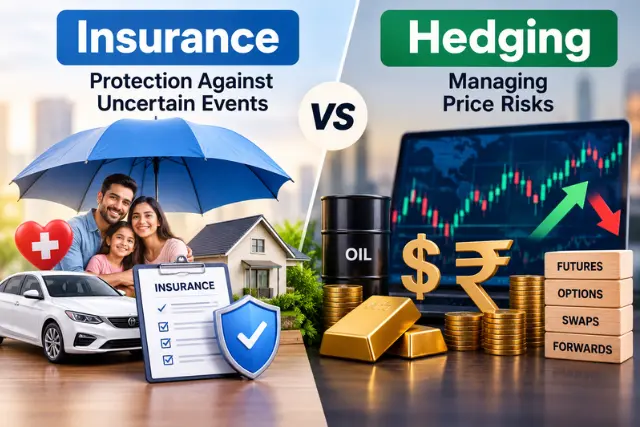
The difference between insurance and hedging is how each manages financial risk. Insurance transfers financial risk to an insurer in exchange for a premium. Hedging reduces financial risk by taking an offsetting position, usually through a financial instrument like futures, options, or a swap. Insurance protects you against uncertain events, such as an accident, an illness, or a fire. Hedging protects you against price movements, such as a currency swing, a commodity price change, or a rate hike. They solve different problems, and a lot of businesses end up using both.
If you want to protect...
| What you're protecting | Choose |
| Health | Insurance |
| Car | Insurance |
| Home | Insurance |
| Business property | Insurance |
| Currency fluctuation | Hedging |
| Commodity prices | Hedging |
| Investment portfolio | Hedging |
If you've ever heard someone say "we're hedging our bets by taking insurance," I get why the confusion exists. Both exist to soften the blow of something going wrong financially. But the mechanics are genuinely different, and mixing them up can lead to bad decisions, such as buying insurance for a problem that hedging would solve better or trying to hedge a risk that only an insurance policy can actually cover.
Here's the one-line version I give people: insurance hands your risk to someone else for a fee. Hedging cancels out your risk by betting the opposite way. That distinction matters whether you're a student, an investor managing a portfolio, or a business owner figuring out what actually protects your company. Understanding why insurance is essential helps explain why protection against events such as illness, accidents, and property damage remains important even when other financial risk-management strategies are available.
Insurance vs Hedging, At a Glance
| Feature | Insurance | Hedging |
| Goal | Transfer risk | Reduce market risk |
| Provider | Insurance company | Financial markets |
| Used by | Everyone | Mostly businesses and investors |
| Examples | Health, car, home | Futures, options, forwards |
| Involves a claim | Yes | No, it's an offsetting trade, not a claim |
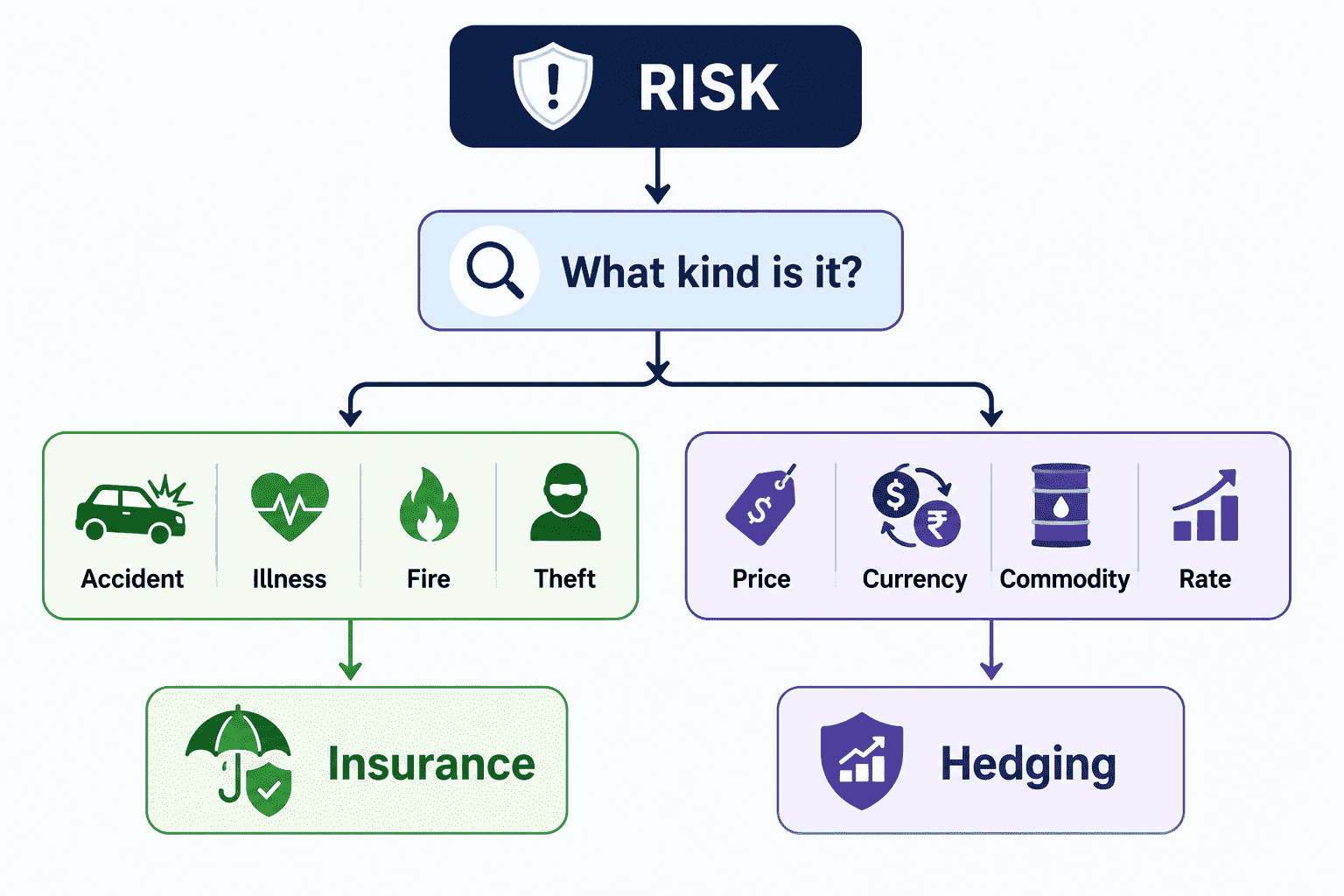
A quick way to sort any risk in your head:
What is insurance?
Insurance is a contract where you pay a company a premium, and in return, the company agrees to compensate you if a specific, uncertain event happens, such as an accident, hospitalisation, death, fire, or theft. You're not predicting when the bad thing will happen. You're paying someone else to absorb the cost if it does. If you want the fuller picture, our what is insurance guide breaks this down from scratch.
The types most people run into include health insurance (hospital bills and surgeries), life insurance (a payout to your family), motor insurance (accident damage, theft, and liability), home insurance (fire, burglary, and structural damage), and business insurance (liability, property, and business interruption). For companies moving goods, coverage often extends to marine insurance, while factories and warehouses may also need fire insurance.
Example: You pay a ₹15,000 annual premium for health cover. You're hospitalised, the bill comes to ₹4 lakh, and you file a claim. The insurer pays it, minus whatever exclusions apply. You've transferred the financial risk of that hospitalisation to the insurer, for a fixed, known cost.
What is hedging?
Hedging is a financial strategy where you take a position that offsets potential losses from another position you already hold. It's not about transferring risk to someone else. Instead, it's about structuring your own exposure so that if one side loses money, the other gains, helping to offset the losses.
The tools people actually use: futures contracts (locking in a price today for a later transaction), options (the right, not the obligation, to buy or sell at a set price), swaps (exchanging one type of exposure for another), forward contracts (a private fixed-price agreement), and diversification (spreading investments so no single loss sinks the portfolio).
Example: An Indian company that imports raw materials and pays in US dollars is exposed to the risk of the rupee weakening. To manage this risk, it can buy a currency forward contract that locks in today's exchange rate for a payment due in three months. If the rupee weakens, the loss on the purchase is offset by the gain on the forward contract. That's hedging, a deliberate counter-position rather than protection purchased from an insurance company.
Insurance vs hedging: the key differences
| Feature | Insurance | Hedging |
| Purpose | Transfers risk to another party | Offsets risk using an opposite position |
| Type of risk covered | Accidents, illness, death, fire, theft, liability | Currency, commodity, interest rate, and price risk |
| Who provides it | An insurance company | Financial markets (futures, options, swaps) |
| Cost | Fixed premium | Trading cost, contract premium, or margin |
| Payout mechanism | Claim settlement | Offsetting gain from the hedge position |
| Who typically uses it | Individuals and businesses | Mostly businesses and investors, though individuals can too |
| Upfront investment needed | No | Usually yes |
| Regulator (India) | IRDAI | SEBI, RBI, and the exchanges (NSE, BSE) |
| Underlying goal | Protection against uncertainty | Reduction of price volatility |
The cleanest way to remember it: insurance deals with whether something bad happens. Hedging deals with how much it costs if a price moves against you.
A few real examples, side by side
Car and health insurance: You total your car or land in the hospital after a sudden diagnosis. The insurer pays the bill according to your policy terms. This is pure risk transfer. You didn't prevent the event, but someone else absorbs the cost.
A farmer hedging wheat prices: Worried that wheat prices might fall before harvest, a farmer locks in a selling price today using a futures contract. If prices do fall, the loss on the crop sale is offset by the gain on the futures position. Nothing was transferred to another party through insurance. Instead, a counterbalance was created to help offset the potential loss.
An exporter hedging currency risk: An Indian exporter expecting a dollar payment in six months worries the rupee might strengthen, shrinking the rupee value of that payment. A forward contract can help manage this exposure by fixing an exchange rate for a future transaction, subject to the applicable terms. The RBI's guidance on foreign exchange derivatives and hedging provides further information about permitted instruments and applicable conditions.
An airline hedging fuel prices: Airlines are famously exposed to jet fuel swings. Many hedge a portion of expected fuel purchases with futures, so a sudden spike in oil prices doesn't blow up operating costs.
What risks does each one cover?
Insurance covers death, illness, fire, theft, accidental damage, third-party liability, and property damage. These are unpredictable events that could affect a specific person or asset. Hedging helps reduce exposure to commodity price swings, currency fluctuations, interest rate changes, stock market volatility, fuel costs, and inflation. If the risk involves a price or rate moving against you, hedging is generally the better fit.
Can insurance replace hedging? Can hedging replace insurance?
No, and this is one of the most common misconceptions about the topic. Insurance generally does not protect you against falling commodity prices, currency depreciation, or losses caused by normal stock market movements. These risks are typically managed through financial instruments rather than standard insurance policies. Hedging works the other way around. It cannot pay your hospital bill, replace your car after an accident, or compensate you for fire damage to your home. A futures contract does not cover physical damage to your factory, which is where property insurance comes in.
They're built for entirely different categories of risk, which is exactly why so many businesses end up holding both rather than treating one as a substitute for the other.
Common confusion worth clearing up
A few incorrect assumptions keep showing up, so it's worth naming them directly:
- "Insurance locks in prices." This is incorrect. Futures or forward contracts are used to lock in prices, while insurance provides financial protection against specified risks and losses.
- "Hedging pays compensation after a loss." It doesn't work through a claims process at all; it works by an offsetting position gaining value when the original position loses.
- "Insurance protects investments." Standard insurance policies generally do not cover market losses on stocks, mutual funds, or investment portfolios. These risks are typically managed through hedging strategies and other investment risk-management techniques.
- "Hedging can replace health insurance." It can't. There's no financial instrument that pays a hospital bill the way a health policy does.
Each of these mix-ups comes from the same root cause: treating "reduces financial risk" as if it means "these are interchangeable." They're not.
Can individuals hedge, or is this just for big companies?
Individuals can hedge their investments, even without calling it hedging. Gold ETFs may help balance equity risk, a mix of domestic and international funds can reduce reliance on a single market, and options can help protect existing stock holdings. These strategies involve understanding which risks you're offsetting and why. However, hedging often requires more financial knowledge and capital than buying insurance, which is why it is more commonly associated with businesses and active investors than with the average household.
Why businesses often use both, not one or the other
This is where many guides fall short, especially when it comes to businesses. An airline buys aviation insurance to cover accident risks and separately hedges fuel costs to manage potential oil price spikes. These strategies address two different risks within the same company, so they complement each other rather than overlap.
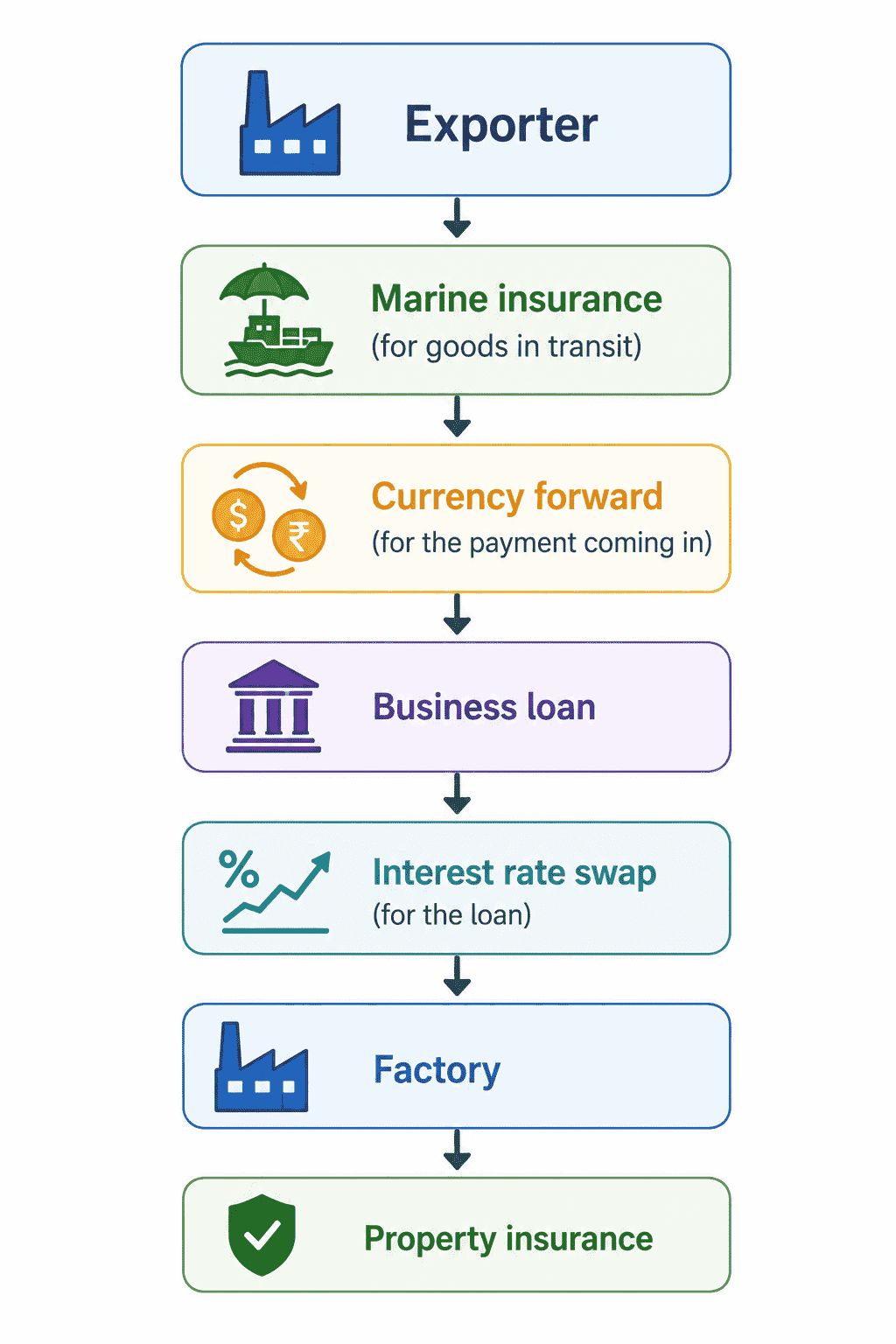
You'll see the same pattern in other industries. A manufacturer insures its factory against fire and liability while hedging the cost of internationally sourced raw materials. An exporter insures shipments against loss in transit while hedging currency risk on expected payments. Even insurance companies hedge their investment portfolios against interest rate risk while using reinsurance to spread their exposure to claims.
These strategies are not redundant. Insurance addresses the risk of unexpected events, while hedging helps manage losses caused by unfavorable price movements. A well-managed business often needs both, along with diversification, because no single strategy can cover every type of risk. If you're exploring this broader approach for the first time, our risk management guide is a useful starting point. You can also read our guide on what reinsurance is to understand how insurers spread their own risk.
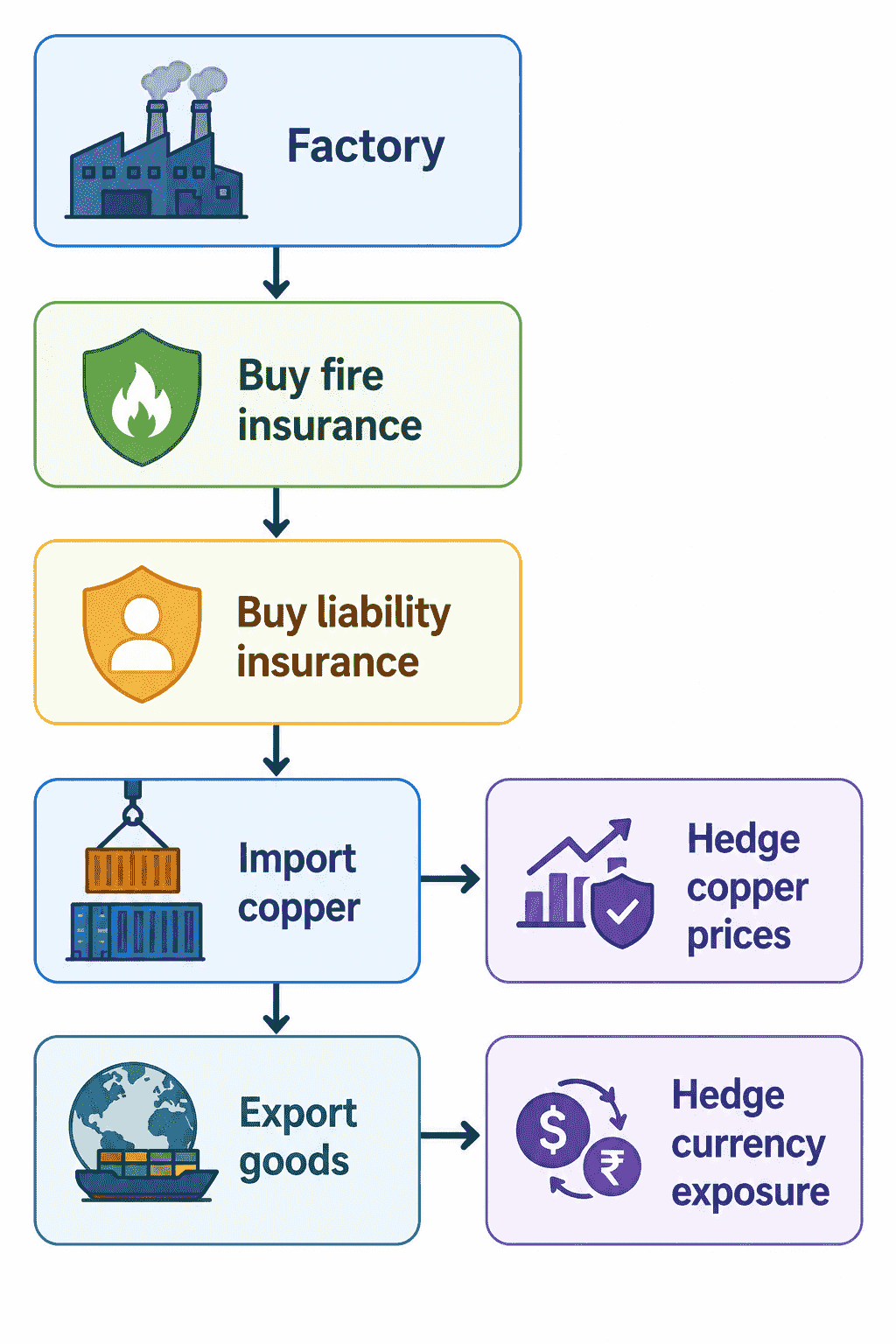
What this looks like in practice, for a mid-sized factory that imports copper and exports finished goods:
In India, insurance and hedging operate within a regulatory framework worth understanding. Insurance products are regulated by the Insurance Regulatory and Development Authority of India (IRDAI). Hedging instruments fall under different regulatory frameworks, depending on their type. The Securities and Exchange Board of India (SEBI) oversees securities and exchange-traded derivatives, while the Reserve Bank of India (RBI) regulates relevant foreign exchange and interest rate transactions. Futures and options are traded on recognised exchanges such as the National Stock Exchange (NSE) and the BSE.
Which one should you choose?
| Your situation | Better option |
| Medical emergency | Insurance |
| Car accident | Insurance |
| House fire | Insurance |
| Family financial protection | Insurance |
| Currency fluctuation on export payments | Hedging |
| Gold or commodity price movement | Hedging |
| Fuel or raw material cost exposure | Hedging |
| Protecting an investment portfolio from volatility | Hedging |
If you're dealing with a personal or family risk involving health, life, property, or liability, insurance is usually the right choice. If you're managing a business or investment exposure linked to price movements or interest rate changes, hedging is designed to help manage that risk.
Can insurance and hedging work together?
Yes, and as a business grows, using insurance and hedging together becomes increasingly common. A construction company may insure its equipment and worksites against damage or theft while hedging steel and fuel costs for ongoing projects. Similarly, an oil company may insure its refineries and pipelines while hedging crude oil price exposure in its trading operations. Combining insurance, hedging, and diversification helps businesses manage different types of risk more effectively.
Here's what that layering typically looks like for an exporter with debt on its books:
A short checklist before you choose
Before deciding which tool fits your situation, run through this:
- Identify the risk precisely — vague worry isn't a risk you can insure or hedge
- Can someone actually insure it? If it's a specific, insurable event, get quotes
- Is it market-related — a price, a rate, a currency? That points to hedging
- Can the risk be reduced through diversification instead of an instrument?
- What's your maximum possible loss if you do nothing?
- What's your budget, and does it favour a fixed premium or a variable hedging cost?
Mistakes businesses specifically make
- Buying comprehensive insurance but ignoring currency risk on international contracts entirely
- Hedging 100% of an exposure when a partial hedge would have been cheaper and nearly as effective
- Confusing speculation with hedging — a hedge should reduce a known exposure, not create a new bet
- Relying only on insurance and assuming it covers market-driven losses it was never designed for
Advantages and limitations of each
Insurance gives you predictability by providing financial protection against potentially devastating events in exchange for a known cost, the premium. However, it only covers risks specified in the policy, and exclusions or sub-limits can leave gaps that you may not discover until you file a claim. Understanding common insurance policy exclusions can help you identify these coverage limitations before buying a policy.
Hedging can neutralise price risk precisely when structured well, without depending on an insurer approving a claim. But it usually needs capital and market knowledge, and a poorly built hedge can lose money on its own, separate from whatever it was meant to offset.
Common myths worth clearing up
Insurance guarantees profit: No, it protects against loss on a covered event, nothing more.
Hedging eliminates all risk: Not quite. It reduces exposure to a specific risk; a badly designed hedge can even add risk.
Insurance is a type of investment: Not usually. A few products, like some life insurance plans, blend in an investment component, but pure protection plans aren't investments.
Only big companies hedge: Individual investors can also hedge through strategies such as diversification, gold investments, and options, often without explicitly calling them hedging.
Common mistakes people make
- Buying insurance and assuming it covers investment losses (it generally doesn't)
- Using hedging instruments to speculate rather than offset a known risk
- Ignoring policy exclusions until claim time
- Getting into derivatives without understanding how they can lose money on their own
- Buying either product without fully understanding the costs involved
A few things worth remembering before you decide
Review your insurance coverage every year, as your personal or business risks may change over time. Only hedge risks you can clearly identify and quantify, because hedging without a defined objective is little more than speculation. Don't confuse investing with hedging, as they serve different purposes even when similar financial instruments are involved. If you run a business of significant size, you may eventually need both insurance and hedging to manage different types of risk effectively.
A short glossary
- Premium - The amount you pay an insurer for coverage, usually annually.
- Claim - A formal request for the insurer to pay out under your policy.
- Futures - A standardised exchange-traded contract to buy or sell an asset at a set price on a future date.
- Options - A contract giving the right, but not the obligation, to buy or sell at a set price before a deadline.
- Forward contract - A private, customised version of a futures contract, agreed directly between two parties.
- Swap - An agreement to exchange one type of financial exposure for another, commonly interest rates or currencies.
- Volatility - How much and how fast a price moves, up or down, over time.
- Exposure - The extent to which you stand to gain or lose from a particular price or event.
- Risk transfer - Moving the financial consequence of a risk to another party, which is what insurance does.
- Risk mitigation - Reducing the likelihood or impact of a risk, which covers both hedging and general risk-management practices.
The bottom line
Insurance protects you against unpredictable events, while hedging helps manage exposure to unfavorable price movements and rate changes. Neither replaces the other. For businesses and investors managing significant financial risks, the best approach often involves using both strategies to address different types of exposure.
Not sure whether you need insurance, hedging, or both to manage your financial risks? Speak with an E-Insure First advisor to understand your risks and explore suitable protection options, with no obligation to purchase a policy.
Frequently asked questions
Is insurance a form of hedging?
Broadly, both insurance and hedging help reduce financial risk, which is why some textbooks group them together. However, they work in different ways. Insurance transfers risk to an insurer, while hedging offsets potential losses through a counter-position. Treating them as interchangeable can lead to poor financial decisions.
What's the biggest difference between insurance and hedging?
Insurance transfers your risk to an insurer for a fixed premium. Hedging offsets your risk yourself using an opposite financial position.
Can individuals use hedging?
Yes, individuals can hedge through diversification, gold investments, international assets, or options on existing holdings. However, these strategies are generally less common among everyday investors because they often require greater market knowledge, careful risk assessment, and additional capital.
Which is cheaper?
It depends on the risk and the instrument. Insurance has a known, fixed premium; hedging costs vary with contract type and market conditions, so there's no single answer.
Why do businesses use hedging?
To manage exposure to market-driven changes in costs and revenues, such as currency fluctuations, commodity prices, and interest rates, where insurance is generally not designed to provide protection.
Does life insurance count as hedging?
Not technically. It's risk transfer against an uncertain event, not an offsetting financial position against a price movement.
Can insurance companies hedge?
Yes. Insurers often hedge interest rate and market risk on their investment portfolios, alongside using reinsurance to spread out claim exposure.
Which is better for investors?
Neither insurance nor hedging is universally better. Investors typically use insurance for personal and financial protection against specified risks, while hedging helps manage portfolio exposure to market movements. Depending on their needs, they may use both strategies at the same time.
Is diversification a hedge?
Broadly, yes. Diversifying investments across assets with low or negative correlations is one of the simplest ways individual investors can reduce portfolio risk, although diversification is not the same as using formal hedging instruments.
Is insurance a risk management tool?
Yes, insurance is one component of a broader risk management strategy. Risk management typically involves four approaches: avoidance, reduction, transfer, and retention. Insurance falls under risk transfer, as it shifts specified financial risks to an insurer in exchange for a premium.
Can hedging make money?
Not usually by design. A well-structured hedge aims to reduce financial risk and limit potential losses rather than generate profits. If the hedge itself becomes the primary source of profit, the strategy may be shifting toward speculation rather than risk management.
Does insurance cover inflation?
Generally, no. Some life insurance and savings-linked products offer inflation-adjusted benefits or riders, but standard protection plans do not automatically increase coverage as prices rise. This is why it's important to review your sum insured periodically to ensure your coverage keeps pace with changing costs.
What is natural hedging?
It's a way of offsetting risk through business operations rather than financial contracts. For example, an exporter that also imports raw materials in the same foreign currency can use incoming and outgoing payments to offset some of its currency exposure without buying any derivatives.
Can small and mid-sized businesses (SMEs) use hedging?
Yes, though it's less common than at large corporates simply because it needs capital and expertise. Many banks now offer simplified forward contracts aimed specifically at SME exporters and importers.
Is hedging legal in India?
Yes. Hedging through recognised exchanges and authorised dealers is legal and regulated by SEBI, the RBI, and the exchanges themselves. What's restricted is unauthorised speculative trading dressed up as hedging.
Do banks hedge risks?
Banks use hedging extensively to manage interest rate risk, currency exposure, and other financial risks associated with their balance sheets. It is a key part of their risk management strategies, helping them limit potential losses and maintain financial stability.
Disclaimer
This article is for general information and educational purposes only and should not be considered financial, investment, or insurance advice. Hedging instruments carry market risk and are regulated separately from insurance products in India. Please consult a licensed financial advisor or an IRDAI-registered insurance advisor before making any decisions. E-Insure First is an independent insurance information platform.