
Written by the E-Insure First Content Team | Reviewed by Sunil Goyal, Director, E-Insure First | Last updated: September 2026
Quick Answer:
A ₹1 crore health insurance plan provides up to ₹1 crore in medical coverage, subject to policy terms. It suits families, metro-city residents, and anyone seeking protection against rising medical inflation. But it isn't automatically the right choice — a ₹50 lakh base plan plus a Super Top-Up can offer similar protection at a lower premium. Compare restoration benefits, room rent limits, waiting periods, and cashless networks — not just the headline number.
Here's a number worth sitting with: a serious cardiac surgery or a month in a metro ICU can cross ₹15–25 lakh today, and advanced cancer treatment can run well past ₹50 lakh over a full course. Suddenly, that ₹5 lakh policy you bought in 2018 looks less like protection and more like a down payment.
That's why insurers now push ₹1 crore plans hard. But the question worth asking isn't "which ₹1 crore plan is best?" — it's "do I actually need ₹1 crore, or is there a smarter way to get there?" Let's answer that honestly.
This guide was prepared after reviewing publicly available insurer brochures, IRDAI consumer guidelines, and current market practices for high sum insured health plans as of September 2026. Before choosing a high sum insured policy, it is also useful to understand the key benefits of health insurance in India and how they support long-term financial protection.
What is a ₹1 Crore Health Insurance Plan?
A ₹1 crore health insurance plan offers medical coverage up to ₹1 crore, subject to the policy's terms and conditions. It is designed to help cover high hospital expenses such as prolonged ICU care, major surgeries, cancer treatment, or organ transplants. Actual benefits depend on waiting periods, exclusions, sub-limits, and other policy features — which is exactly why two ₹1 crore plans can behave very differently at claim time.
What major treatments actually cost in India
| Treatment | Approximate Cost Range* |
| Heart bypass surgery | ₹4 – 10 lakh |
| Cancer treatment (long-term course) | ₹20 – 60 lakh+ |
| Organ transplant | ₹20 – 40 lakh+ |
| Multi-week ICU stay | ₹10 – 25 lakh |
*Illustrative ranges — actual costs vary by hospital, city, treatment protocol, and complications. Put two of these events in one family within a few years, and the case for high coverage makes itself.
Do You Really Need ₹1 Crore Health Insurance?
It genuinely makes sense if you're…
- A family on one floater - the sum insured is shared, so ₹1 crore across four people isn't as oversized as it sounds
- A metro resident - Mumbai, Delhi, and Bengaluru private hospital costs run 40–60% higher than tier-2 cities
- A high-income professional - protecting savings and investments from a single medical event
- Someone with family history of cancer, cardiac, or kidney conditions — where multi-stage treatment costs compound
- A long-term planner - the cover you buy at 30 should still be adequate at 55, and medical costs in India have historically risen faster than general inflation
Who may not need ₹1 crore coverage
- Young, healthy singles with employer cover - a mid-size personal plan (₹10–25 lakh) with an upgrade path at life milestones may be more cost-effective
- Residents of smaller cities - where quality private treatment costs a fraction of metro rates, a lower base with a Super Top-Up often fits better4
- Budget-constrained buyers - for whom the base + Super Top-Up combination (next section) delivers comparable protection at a lower premium
Not needing ₹1 crore today doesn't mean not needing health insurance — it means sizing the structure to your life stage and reviewing it as things change.
₹50 Lakh vs ₹1 Crore vs Super Top-Up: The Comparison That Matters
| Feature | ₹50 Lakh Base | ₹1 Crore Base | Base + Super Top-Up |
| Coverage level | High | Very high | Very high (combined) |
| Premium | Lower | Higher | Usually the lowest for equivalent cover |
| Claim simplicity | Single policy | Single policy | Two policies, deductible coordination |
| Inflation protection | Moderate | Strong | Strong (depends on deductible) |
| Best for | Individuals, tier-2 cities | Families, metros, simplicity seekers | Budget-conscious smart structurers |
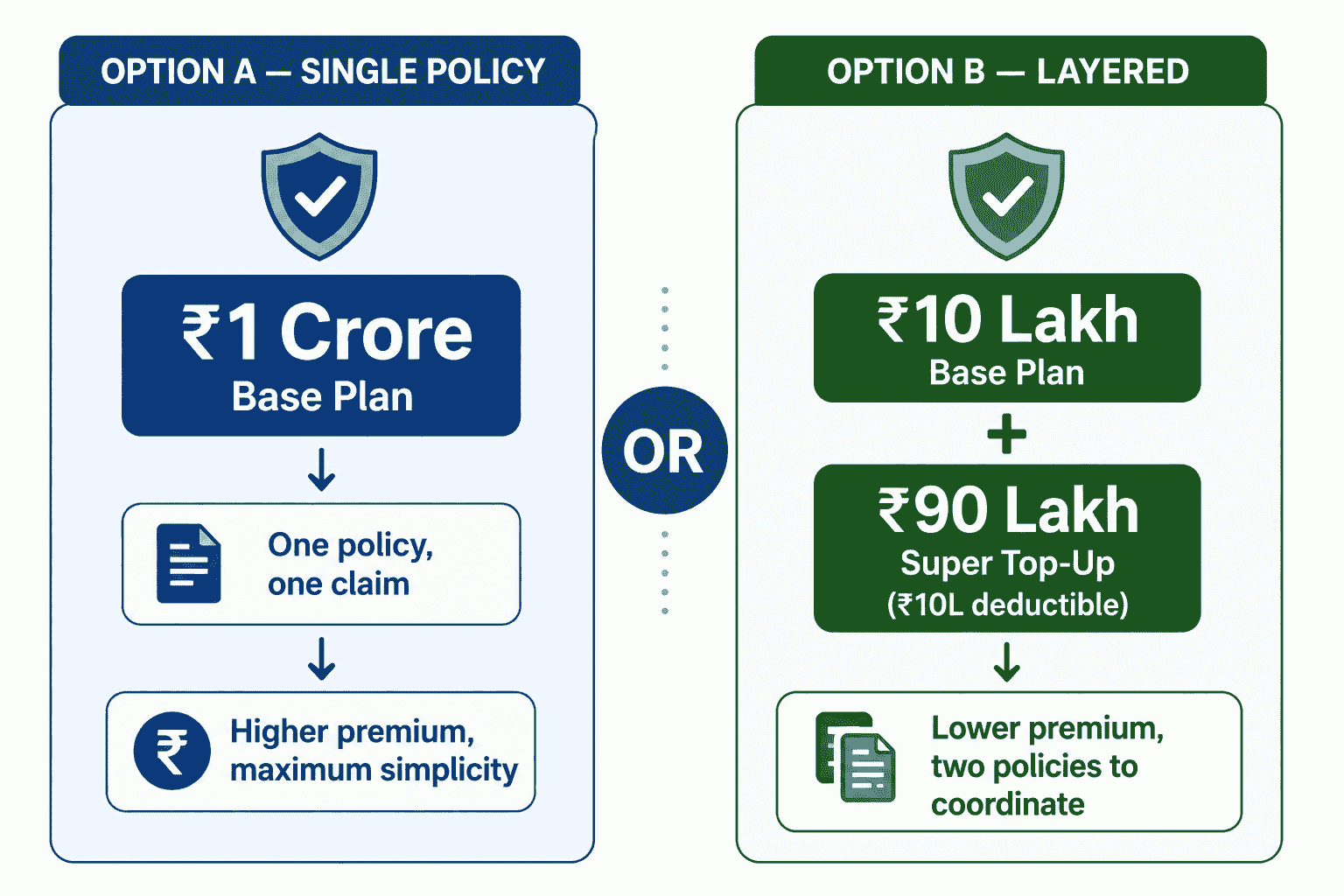
The Super Top-Up secret most agents skip: a ₹10 lakh base policy plus a ₹90 lakh Super Top-Up (with ₹10 lakh deductible) often costs meaningfully less than a full ₹1 crore base plan — while covering the same catastrophic scenario. The trade-off is coordinating two policies at claim time. If premium is your constraint, price this structure before dismissing ₹1 crore-level protection.
The two structures, side by side
Which structure fits which buyer?
| Situation | Recommended Structure |
| Family in a metro city, wants simplicity | ₹1 crore base plan |
| Budget-conscious buyer | Base + Super Top-Up |
| Senior citizen | Depends heavily on underwriting & co-pay terms — compare both |
| Young professional building first cover | Mid-size base now, Super Top-Up added later |
How Much Does a ₹1 Crore Plan Cost?
Premiums depend on age, city, family size, medical history, tobacco use, and add-ons — so treat these as orientation, not quotes: a healthy 30-year-old individual might pay roughly ₹12,000–₹20,000/year; a young family floater (2 adults + 1 child) commonly lands around ₹20,000–₹40,000/year; and premiums climb steeply after 45, with senior entrants often facing medical underwriting or co-payment terms.
Verify before you compare: insurer pricing changes frequently, and the gap between insurers for the same profile can be 30–40%. Get current quotes for your exact age and city — or use our premium calculator for a quick estimate.
What ₹1 Crore Plans Typically Offer (And the Fine Print to Check)
Leading insurers — HDFC ERGO, Niva Bupa, Care Health, Star Health, Aditya Birla, ICICI Lombard — all offer high sum insured plans with broadly similar headline features: restoration benefit, No Claim Bonus, large cashless networks, day-care procedures, pre/post-hospitalisation cover, and ambulance benefits. Since features and variants change often, we deliberately don't quote plan-specific terms here — verify current brochures, or let us shortlist for your profile.
What separates a useful health insurance policy from a marketing headline is the fine print. Along with room rent limits, restoration rules, waiting periods, and co-payment clauses, you should also review the policy's exclusions. Our guide to common insurance policy exclusions explains the types of expenses that may not be covered.
- Room rent limits - a capped room category can proportionately shrink your entire claim, not just the room bill
- Restoration conditions - does it trigger on partial or only full exhaustion? Same illness or only unrelated ones? Unlimited times or once a year?
- Waiting periods - initial 30 days, specific illnesses, and pre-existing conditions (up to 3 years under current IRDAI norms)
- Consumables - gloves, syringes, PPE can be 5–10% of an ICU bill; check if a consumables add-on exists
- Co-payment and disease-wise sub-limits - A ₹1 crore plan with a 20% co-payment can leave you paying a significant part of the eligible claim from your own pocket. Read our guide on what is copayment in health insurance to understand how this clause affects your actual claim payout.
Restoration benefit, in one example
For example, if a cardiac emergency uses ₹95 lakh of your ₹1 crore floater in June — with restoration, the sum insured refills — so when a second family member is hospitalised in November, a fresh ₹1 crore is available. Without it, you'd have ₹5 lakh left for the rest of the year. This single feature is why floater families should treat restoration terms as non-negotiable.
Compare ₹1 crore health insurance plans based on your city, age, and family size — get unbiased guidance from an EInsureFirst advisor, with no obligation to purchase.
₹1 Crore Personal Plan vs Employer Insurance
| Employer Group Plan | Personal ₹1 Crore Plan |
| Ends the day you leave the job | Portable — stays through job changes and retirement |
| Employer decides the cover (often ₹3–5 lakh) | You choose the coverage and add-ons |
| No say in features or network | Flexible customisation |
| Temporary by design | Long-term, locks in insurability while healthy |
The two aren't rivals — keep the employer plan as your first claim layer and let the personal policy protect your family's long game.
Should You Buy One? (Decision Tree)

Common Mistakes (Learn From Other People's Claims)
- Buying the ₹1 crore headline and ignoring room rent caps, co-pays, and sub-limits that quietly shrink it
- Assuming restoration is unconditional — the conditions are where plans genuinely differ
- Skipping the cashless network check — verify your preferred hospitals in our cashless network guide
- Comparing premium alone — the cheapest ₹1 crore plan is often cheap for discoverable reasons
- Waiting for the "right age" — every birthday raises the premium and risks a new diagnosis complicating underwriting
Expert Tip: The answers to the six questions below separate real ₹1 crore protection from a ₹1 crore brochure — get them in writing before you pay a single premium.
Questions to Ask Before Buying a ₹1 Crore Plan
- Is there a room rent limit, and what happens to the claim if I choose a higher room category?
- What exactly triggers the restoration benefit — partial or full exhaustion? Same illness or unrelated only? How many times a year?
- Are there co-payment clauses — by age, city, or hospital type?
- Are consumables covered, or is there an add-on for them?
- Which of my preferred hospitals are in the cashless network?
- What are the waiting periods for pre-existing conditions and specific illnesses on this exact variant?
Individual Plan or Family Floater — Which Way for ₹1 Crore?
| Factor | Individual ₹1 Cr (each member) | Family Floater ₹1 Cr (shared) |
| Coverage | Dedicated per person | Shared across the family |
| Premium | Higher in total | Lower for equivalent headline cover |
| Best for | Senior parents; members with health conditions | Young families with healthy members |
| Watch out for | Cost stacking as members age | One large claim can consume the shared pool — restoration becomes critical |
Many families choose a hybrid structure: a family floater for the nuclear family and separate individual policies for senior parents, whose age may increase the overall floater premium. Before making this decision, compare the top health insurance companies in India and review their eligibility, co-payment, waiting period, and network hospital terms.
Common Myths About ₹1 Crore Health Insurance
- "₹1 crore covers everything." No — exclusions, waiting periods, room rent caps, and sub-limits apply exactly as they do on smaller plans. The number is a ceiling, not a promise.
- "₹1 crore plans are unaffordable." Premiums are frequently lower than people assume — high sum insured pricing doesn't scale linearly, and layered structures cut it further.
- "Only the wealthy need this much cover." Backwards, if anything — a ₹40 lakh hospital bill is survivable for the wealthy and financially devastating for everyone else. High cover protects modest savings hardest.
- "My ₹5 lakh employer policy is enough." Against a single major treatment costing ₹20 lakh+, it isn't — and it disappears with your job.
Key Takeaways
- ₹1 crore is strong protection, not a default answer — families and metro residents benefit most.
- Base + Super Top-Up can match it for less — price both structures before buying.
- The fine print is the product — room rent caps, restoration triggers, co-pays, and sub-limits decide what actually gets paid.
- Employer cover complements, never replaces, a personal policy.
- Buy young, review often — premiums and insurability only get harder with time.
Find Your Right-Sized Health Cover — Free Comparison
Whether it's a full ₹1 crore plan or a smarter base + Super Top-Up structure, our advisors will compare current options for your exact age, city, and family — clearly, and without any obligation to purchase.
Official Sources
- Insurance Regulatory and Development Authority of India (IRDAI) — regulations and consumer guidance
- IRDAI Policyholder Education Portal — rights, grievances, and buying guidance
- Official policy brochures and wordings of HDFC ERGO, Niva Bupa, Care Health, Star Health, Aditya Birla Health, and ICICI Lombard
- Bima Bharosa Grievance Portal
Frequently Asked Questions
Is ₹1 crore health insurance enough for a family?
For most families, comfortably yes — it covers major treatment, transplants, and long ICU stays at current metro costs, especially with restoration refilling the cover after a claim. Reassess every few years as medical costs climb.
How much does a ₹1 crore health insurance plan cost?
Indicatively, ₹12,000–₹20,000/year for a healthy 30-year-old individual and ₹20,000–₹40,000 for a young family floater — but pricing varies 30–40% between insurers for the same profile. Get current quotes before deciding.
Is ₹1 crore better than ₹50 lakh?
Not automatically. ₹1 crore buys headroom and simplicity; a ₹50 lakh base (or smaller) plus a Super Top-Up often delivers equivalent catastrophic protection for less premium. Structure beats size.
What is a restoration benefit?
It automatically refills your sum insured after claims exhaust it during the policy year, so a second hospitalisation isn't left uncovered. Conditions vary — partial vs. full exhaustion, same vs. unrelated illness — so read the trigger rules.
Does employer insurance replace a personal policy?
No — it ends with the job, caps low, and you don't control it. Use it as the first claim layer; keep a personal policy as the permanent foundation.
Can senior citizens buy ₹1 crore health insurance?
Many insurers allow it, but expect steeper premiums, medical underwriting, and possible co-payment clauses. For seniors, co-pay terms and cashless networks deserve more scrutiny than the headline cover.
Can I increase my sum insured later?
Yes — at renewal, subject to the insurer's approval and possibly fresh underwriting. No Claim Bonus also grows cover automatically in many plans. Still, buying adequate cover early beats upgrading after a diagnosis, which may be declined.
Are maternity benefits included in ₹1 crore plans?
Sometimes, maternity coverage is available as an optional benefit with its own waiting period, eligibility conditions, and sub-limit. The ₹1 crore sum insured does not automatically apply to maternity expenses. Read our guide on maternity health insurance with no waiting period to understand the available options and important policy conditions.
Disclaimer: This article is for general information only and does not constitute insurance or financial advice. Premium ranges are indicative as of September 2026 and vary by insurer, age, city, health profile, and plan variant. Plan features, restoration conditions, and waiting periods change frequently — always verify the latest policy wordings and brochures from the insurer or IRDAI-registered sources before purchasing. E-Insure First is an independent insurance information platform.