Written by the E-Insure First Content Team | Reviewed by Sunil Goyal, Director, E-Insure First | Last updated: September 2026
Quick Answer
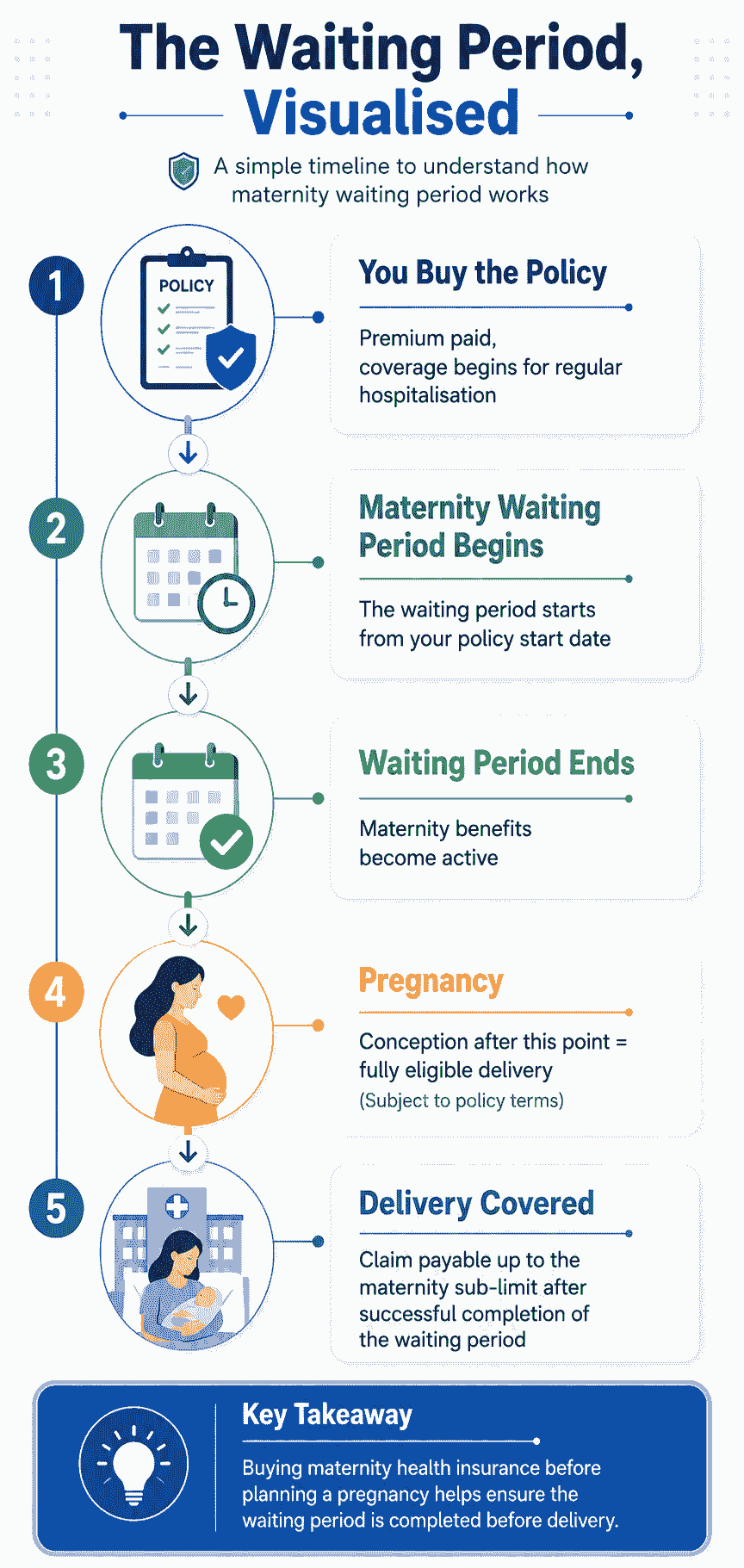
Maternity health insurance with no waiting period is uncommon in individual retail health insurance plans in India. Most individual maternity health insurance plans in India have a waiting period, typically ranging from 9 months to 4 years. Truly "no waiting period" maternity coverage is uncommon in retail policies. However, employer-sponsored group health insurance frequently covers maternity from day one, and a few women-focused plans offer waiting periods as short as 9-12 months. Always verify the policy wording before purchase.
Let's start with the honesty most articles on this topic avoid: if you're searching for health insurance with maternity coverage and no waiting period, chances are there's already good news at home, but now you're discovering that insurance doesn't quite work the way you hoped. You deserve a straight answer, not a sales pitch.
So here it is: as of September 2026, most individual maternity health insurance plans in India include a waiting period, and retail plans offering true day-one maternity coverage are extremely uncommon. But this is the part worth reading for: there are three genuine routes to getting your delivery costs covered or reduced, depending on where you are in your pregnancy journey. This guide walks through all of them, plus the waiting-period comparison and planning strategy for couples who still have time on their side.
Can You Get Maternity Insurance Without a Waiting Period?
In most cases, no. Individual maternity health insurance plans in India usually have waiting periods ranging from several months to multiple years. Immediate maternity coverage is more commonly available through certain employer-sponsored group health insurance policies, subject to their terms and conditions. Always verify the latest policy wording before purchasing.
Is Maternity Health Insurance With No Waiting Period Really Available?
Here's the market reality, policy type by policy type:
| Policy Type | Maternity Waiting Period | Immediate Cover Possible? |
| Individual health plan | Usually 9 months - 4 years | Rare |
| Family floater plan | Usually 1 - 4 years | Rare |
| Employer group health insurance | Often none | Frequently - day one |
| Group plans via associations/banks | Varies | Sometimes |
Why the search results mislead you: many pages ranking for this keyword list regular maternity plans and quietly mention the waiting period in paragraph nine. The truth is simpler, the phrase "no waiting period" in Indian maternity insurance almost always points to group insurance through your employer, not a plan you can buy off the shelf today.
What about "Star Health insurance with maternity coverage no waiting period"?
Do not assume that a Star Health plan offers maternity coverage from day one. Maternity waiting periods and benefits vary by product and policy variant. Check the latest official Star Health policy wording before relying on any claim about zero waiting period or a specific waiting period. The same pattern holds across HDFC ERGO, Care, Niva Bupa, and Aditya Birla: shorter waiting periods exist; zero doesn't. Verify the latest policy wording on the insurer's official site. These terms can be revised.
Why Do Insurers Impose a Maternity Waiting Period?
Understanding the "why" saves you from chasing loopholes that don't exist. Pregnancy is what insurers call a planned, predictable expense, unlike an accident or sudden illness. If zero-waiting maternity plans existed, everyone would buy them in month two of pregnancy, claim ₹80,000 in month nine, and cancel, creating a guaranteed loss on every policy. The industry calls this anti-selection. Waiting periods keep maternity benefits viable and premiums affordable for everyone in the risk pool. It's not a trick; it's the only way the math works.
The four waiting periods you should know
| Waiting Period | Typical Duration | Applies To |
| Initial waiting period | 30 days | All illnesses except accidents |
| Maternity waiting period | 9 months - 4 years | Delivery, C-section, related expenses |
| Pre-existing disease (PED) | Subject to the policy's stated waiting period and applicable IRDAI rules. | Conditions existing before purchase |
| Specific illness waiting | 1 - 3 years | Listed conditions (hernia, cataract, etc.) |
For the full picture of how these interact, see our health insurance waiting period guide.
Can You Buy Health Insurance After Becoming Pregnant?
Yes and no. You may be able to apply for health insurance while pregnant, but acceptance depends on the insurer's underwriting rules and the product's terms. Pregnancy-related expenses for the current delivery are generally not covered if the policy's maternity waiting period has not been completed. Disclose your pregnancy honestly when applying and check the policy wording before purchase.
What buying now still gets you:
- Coverage for non-maternity hospitalisation, including illness or accidents during pregnancy that aren't maternity-related
- The waiting-period clock starts ticking for a future second pregnancy
- Newborn coverage from the next policy stage, depending on plan terms
Disclose the pregnancy. Hiding it on the proposal form to sneak past underwriting is the kind of non-disclosure that gets claims rejected and policies cancelled. Honest disclosure costs nothing here, because maternity wasn't going to be covered anyway, and it protects every other benefit of the policy.
The 3 Real Routes to Immediate (or Near-Immediate) Maternity Coverage
Route 1: Employer group health insurance: the genuine "no waiting period" option
This is the answer the search engines should give you first. Some employer-sponsored group health insurance policies may cover maternity from day one, subject to the employer's negotiated benefits and policy terms. If either you or your spouse is salaried:
- Ask HR for the group policy document and read the maternity clause: coverage amount, normal vs. C-section limits, and newborn cover.
- Check whether your spouse is enrolled as a dependent, as many policies cover dependent spouses' deliveries.
- If you're job-hunting anyway, group maternity benefits are a legitimate factor to consider, as coverage often starts on your joining date.
Route 2: Government maternity schemes: support, not insurance
These don't replace insurance, but they meaningfully reduce out-of-pocket costs for eligible families:
- Janani Suraksha Yojana (JSY): Cash assistance for institutional deliveries, targeted at low-income mothers, with amounts varying by state category
- Pradhan Mantri Matru Vandana Yojana (PMMVY): ₹5,000 benefit for the first child (₹6,000 for a second girl child), paid in instalments linked to health checkups
- Janani Shishu Suraksha Karyakram (JSSK): The quiet giant: completely free delivery, including C-section, at government hospitals, with free medicines, diagnostics, and transport
A government hospital delivery under JSSK plus PMMVY support can bring the cost of a normal delivery close to zero — a fact worth knowing even if you ultimately choose a private hospital.
Route 3: Buy early and let the waiting period work for you
If you're planning rather than expecting, the waiting period stops being an obstacle and becomes a calendar entry. A plan with a 2-year maternity waiting period bought today covers a delivery in year three, and the shorter-waiting options, 9–12 months on select women-focused plans, narrow the gap further. The couples who never face this problem are the ones who bought maternity cover when they got married, not when the test turned positive.
The best time to buy maternity insurance is the day you start thinking about a family not the day you confirm one. Every month of delay is a month added to your effective waiting period. - Sunil Goyal, Director, E-Insure First
What Maternity Insurance Covers (And What It Doesn't)
| Usually Covered | Usually Not Covered |
| Normal delivery (within sub-limit) | Delivery during the waiting period |
| C-section (often a higher sub-limit) | Expenses beyond the maternity sub-limit |
| Hospitalisation for delivery | Non-medically necessary services |
| Pre & post-natal expenses (typically 30–60 days, if included) | Cosmetic or elective procedures |
| Newborn cover from birth (many plans) | IVF/infertility treatment (unless the plan specifically includes it) |
| Pregnancy complications (per policy terms) | Treatments outside policy scope |
The sub-limit surprise: Maternity benefits usually have their own cap, often ₹25,000 to ₹1 lakh, regardless of your total sum insured. A ₹10 lakh policy with a ₹50,000 maternity sub-limit pays ₹50,000 for delivery. Always ask for the maternity sub-limit in writing before buying.
What newborn cover may include
- NICU expenses (if covered - the single most valuable line item)
- Congenital condition treatment (subject to policy terms)
- Vaccinations (plan-dependent, often first-year)
- Newborn hospitalisation from day one of birth
- Follow-up care where applicable
Newborn terms vary more than any other maternity feature. Some plans include cover automatically, others as a paid add-on, and sub-limits differ widely. Understanding the benefits of health insurance in India can help you compare the broader protection available under a policy.
If NICU cover matters to you (and statistically, it should), make it the first question you ask.
Questions to ask the insurer before buying
- What is the exact maternity waiting period on this variant?
- What is the maternity sub-limit, and is it different for normal delivery vs. C-section?
- Is newborn cover automatic or an add-on, and does it include NICU?
- Are pregnancy complications covered, and under which section of the policy?
- Is there a room rent cap, and how does it affect maternity claims?
- Which maternity hospitals near me are in the cashless network?
Policy comparison checklist
| Check | Why It Matters |
| Waiting period | Determines whether your delivery is eligible at all |
| Maternity sub-limit | The actual payout - not the headline sum insured |
| Newborn cover & NICU | NICU bills can exceed the delivery cost itself |
| Room rent limit | A low cap proportionately shrinks the entire claim |
| Cashless hospital network | Easier admission when it matters most |
If you are comparing broader health insurance options, our guide to the top 10 health insurance companies in India can help you explore the wider market.
Maternity Waiting Periods: What Popular Insurers Offer
| Insurer (Popular Maternity-Benefit Plans) | Waiting Period Position* | Newborn Cover Option |
| Star Health (Women Care & others) | Among the shorter options in the market, variant-dependent | ✓ |
| Care Health (Joy & others) | Shorter-waiting variants available | ✓ |
| Niva Bupa (select plans) | Shorter-waiting variants available | ✓ |
| Aditya Birla (Activ plans) | Varies by plan and variant | ✓ |
| HDFC ERGO (select plans) | Typically longer waiting periods | ✓ |
| ICICI Lombard (select plans) | Typically longer waiting periods | ✓ |
*Indicative waiting periods vary by plan variant and are revised frequently by insurers. Refer to the latest policy brochure and wording on the insurer's official website, or ask a licensed advisor, before making any decision. We deliberately avoid quoting exact months here because a number that's right today can be wrong next quarter.
What Does Delivery Actually Cost in India?
To decide whether to wait, self-fund, or restructure your plans, you need the number you're insuring against:
| Delivery Type | Government Hospital | Private Hospital (Tier-2 City) | Private Hospital (Metro) |
| Normal delivery | Free - nominal (JSSK) | ₹25,000 - ₹60,000 | ₹50,000 - ₹1,50,000 |
| C-section | Free - nominal (JSSK) | ₹50,000 - ₹1,20,000 | ₹1,00,000 - ₹2,50,000+ |
Illustrative ranges only. Actual costs vary by city, hospital brand, room category, and complications. NICU care for the newborn, if needed, can add substantially to the total cost. This is exactly where good newborn cover can prove valuable.
Which Option Is Right for You? (Decision Tree)
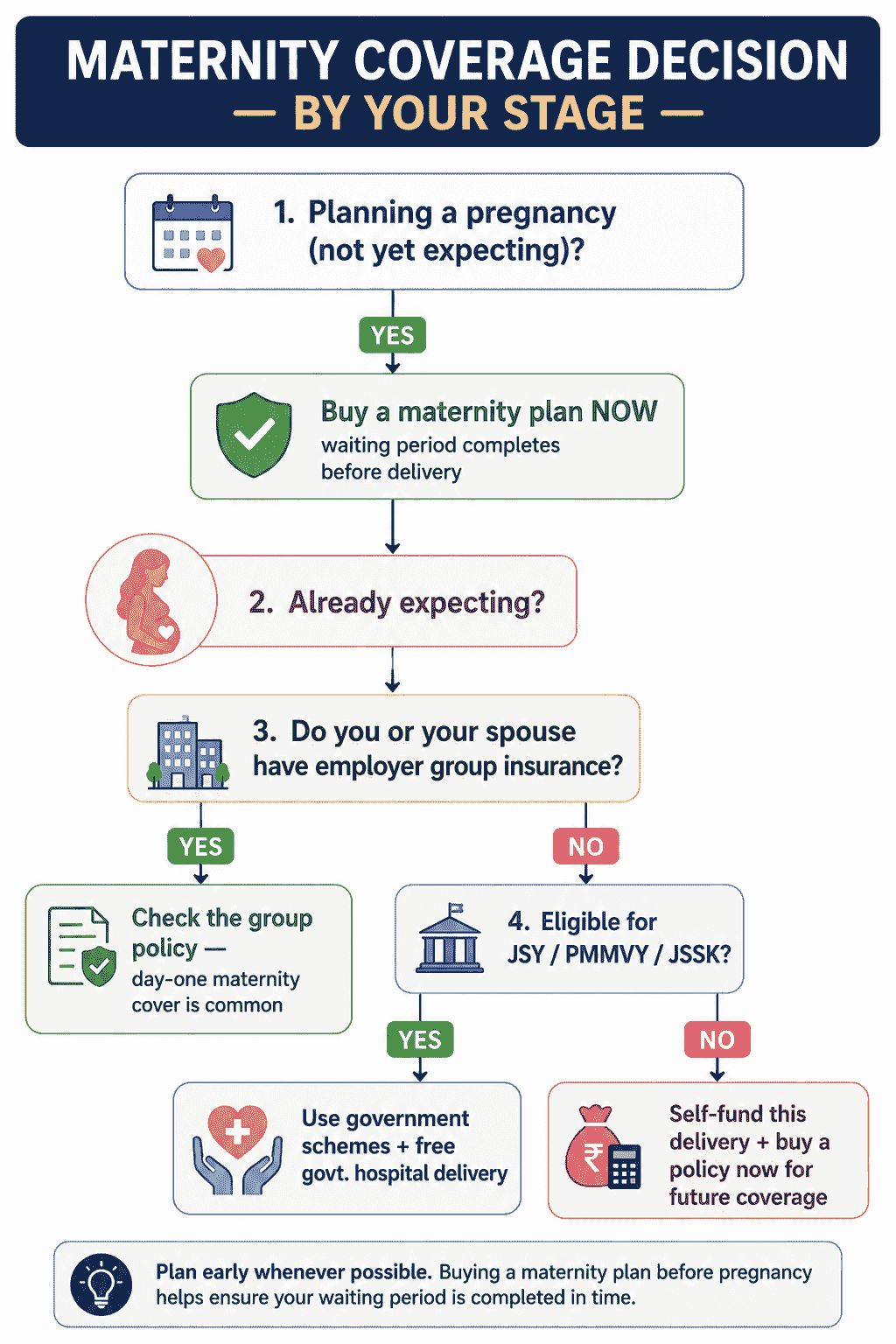
Which option works best? At a glance
| Your Situation | Best Option |
| Planning pregnancy (1-3 years away) | Buy maternity insurance now - let the waiting period run out |
| Already pregnant | Check employer group policy first - day-one cover is common |
| No employer cover, already expecting | Government schemes (JSY/PMMVY/JSSK) + planned self-funding |
| Newly married, no fixed timeline | Choose the shortest waiting-period plan you can afford |
Who Should Consider Maternity Health Insurance?
- Newly married couples - buying now means the waiting period finishes before you need it
- Couples planning pregnancy within 1–3 years - the sweet spot where planning beats waiting
- Working professionals without employer maternity benefits - freelancers, business owners, and employees at companies without group cover
- Families wanting a private hospital delivery - where costs run ₹50,000 to ₹2.5 lakh+
- Women who want newborn cover from day one - NICU costs are the hidden financial risk of any delivery
Who may not benefit immediately
Balanced advice cuts both ways. A maternity plan may not help you right now if:
- You're already in the later stages of pregnancy. No retail plan's waiting period can be completed in time.
- Your expected delivery date falls before any available waiting period ends.
- Your employer already provides comprehensive maternity cover. Paying twice for the same benefit rarely makes sense, although a personal policy can still protect you between jobs.
How to Choose the Right Maternity Plan: The Checklist
- Waiting period: The shorter, the better for your timeline
- Maternity sub-limit: Check whether it is realistic for delivery costs in your city
- Delivery-specific limits: Check whether separate limits apply to normal delivery and C-section
- Newborn baby cover: Confirm whether it is automatic or optional and from which day it begins
- Pre- and post-natal expenses: Check what is covered and for how long
- IVF and infertility coverage: Review this if it is relevant to you
- Room rent limits: A low room cap can proportionately reduce other payouts
- Cashless network hospitals near your home: Check our cashless network guide
- Claim settlement track record: Review the insurer’s claims history
- Premium versus benefits: The cheapest plan is rarely the best option here
Common Mistakes Buyers Make
- Buying after pregnancy confirmation: Expecting immediate cover is the biggest disappointment on this topic
- Comparing premiums but ignoring waiting periods: A cheaper plan with a four-year wait may be useless for your timeline
- Ignoring the maternity sub-limit: A high sum insured means little if maternity coverage is capped at ₹25,000
- Missing the employer benefit in your inbox: Check the group policy before buying anything
- Skipping the exclusions page: IVF, surrogacy, and certain complications have plan-specific terms
- Assuming every maternity expense is covered: Read what is included and excluded in writing
Expert Tip: When comparing plans, calculate your "effective coverage date": today's date + the maternity waiting period. If that date lands after your planned delivery window, that plan cannot help this pregnancy — no matter how attractive the brochure. This single calculation filters your shortlist in two minutes.
Key Takeaways - What to Remember
- Zero-waiting-period maternity insurance: It is essentially a myth in Indian retail plans, where waiting periods of 9 months to 4 years are common.
- Employer group insurance: This is the real “no waiting period” option, so check with HR before searching Google.
- Already pregnant? Consider this route: group cover → government schemes such as JSY, PMMVY, and JSSK → smart self-funding. You can also buy a policy now for future protection.
- Maternity sub-limits: These matter more than the total sum insured for maternity claims, so get the maternity cap in writing.
- Buy before you plan, not after you confirm: The waiting period becomes an obstacle when you purchase cover too late.
Official Sources
- Insurance Regulatory and Development Authority of India (IRDAI) - consumer guidance and regulations
- Ministry of Health & Family Welfare - maternal health programmes
- Pradhan Mantri Matru Vandana Yojana (PMMVY) - official scheme portal
- National Health Mission - Janani Suraksha Yojana (JSY) & Janani Shishu Suraksha Karyakram (JSSK)
- Official policy brochures and wordings of Star Health, HDFC ERGO, Niva Bupa, Care Health, Aditya Birla Health, and ICICI Lombard
Frequently Asked Questions
Is there any maternity insurance with no waiting period in India?
In individual retail plans, genuinely zero-waiting-period maternity coverage is rare to non-existent. Waiting periods of 9 months to 4 years are common. The realistic exception is employer group health insurance, which frequently covers maternity from day one. Verify the policy wording before relying on any plan.
Can I buy maternity insurance after becoming pregnant?
You can buy health insurance while pregnant with honest disclosure, but the current delivery generally won't be covered. Pregnancy is usually treated as a pre-existing condition, and the waiting period may not be completed in time. The policy can still cover non-maternity hospitalisation now and future pregnancies later.
Does Star Health offer maternity coverage with no waiting period?
No. Star's shortest maternity waiting periods are available through Star Women Care, with options starting at around 12 months depending on the variant. Other Star plans typically require about 24 months. No Star retail plan offers zero-waiting-period maternity coverage. Confirm the current terms on Star Health's official website.
Does employer health insurance cover pregnancy immediately?
Very often, yes - many corporate group policies cover maternity from day one with sub-limits of ₹50,000-₹1 lakh, sometimes covering dependent spouses too. The exact benefit depends on what your employer negotiated, so ask HR for the maternity clause specifically.
Which insurer has the shortest maternity waiting period?
Women-focused plans currently offer the shortest waiting periods. Select variants from insurers such as Star Women Care, Care, Niva Bupa, and Aditya Birla may offer waiting periods of around 9-12 months, usually at higher premiums or specific sum-insured tiers. Terms change frequently, so compare the latest policy wordings before deciding.
Are normal delivery and C-section both covered?
Yes, once the waiting period is complete. Coverage typically comes with separate sub-limits, with C-section usually having the higher limit. Both remain subject to the overall maternity sub-limit, which is often much lower than the base sum insured.
Does maternity insurance include newborn expenses?
Many plans cover newborns from the day of birth, including hospitalisation, treatment for congenital conditions, and sometimes vaccinations, until the policy renewal date. Whether this coverage is automatic or available as an add-on varies by plan. NICU-related situations make newborn coverage one of the most valuable features to check.
Are prenatal and postnatal expenses covered?
Frequently, for a defined window (commonly 30-60 days before and after delivery) and within the maternity sub-limit. Some plans cover these only during hospitalisation, so read whether outpatient consultations and scans qualify.
Do government maternity schemes replace health insurance?
No. JSY and PMMVY provide cash support, while JSSK makes government-hospital delivery free. These schemes are genuinely valuable, but none covers private hospitals, major complications, or ongoing family health protection in the same way insurance does. Think of them as complements, not substitutes.
Can I reduce the maternity waiting period?
Not through a waiver on individual plans, but effectively yes, in three ways: choose a plan with a 9–12-month waiting period, use employer group cover, which often has no waiting period, or buy early so the waiting period ends before you need the coverage. The waiting period mainly affects people who start late.
Disclaimer: This article is for general information only and does not constitute insurance, medical, or financial advice. Waiting periods, sub-limits, benefits, and plan availability vary by insurer and change frequently. The ranges mentioned are indicative as of September 2026. Always verify current policy wordings using official insurer documents and IRDAI-registered sources before purchasing. Government scheme eligibility and benefits, including JSY, PMMVY, and JSSK, are subject to the official terms published by the Ministry of Health & Family Welfare and the respective state governments.