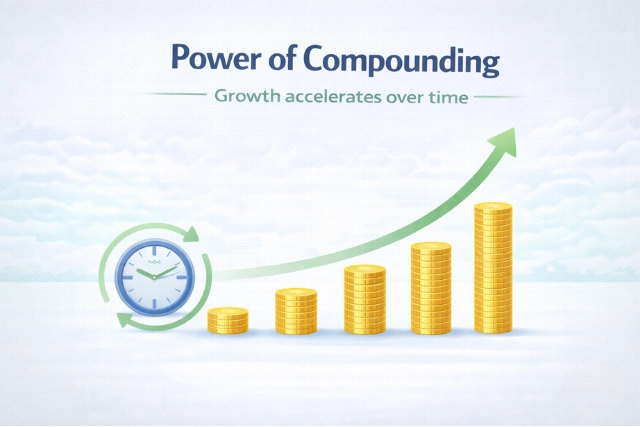
If you’ve ever wondered how some investors grow small savings into large amounts of wealth over time, the answer often comes down to the power of compound interest.
Compound interest allows your money to grow not only on the original amount you invest but also on the returns your investment earns over time. This “interest on interest” effect is one of the biggest reasons long-term investors build wealth faster.
The earlier you start investing and the longer you stay invested, the more powerful compound interest becomes. If you are new to investing, this beginner’s guide to investment explains the basics in simple terms.
Quick Answer
The power of compound interest refers to the process where your investment earns returns not only on the original principal amount but also on the accumulated interest over time. The longer money remains invested, the faster it can grow because of compounding.
Compound Interest Meaning
Before we dive into the details of compound interest, let’s first understand the basic concept. Compounding interest is the process by which an investment earns interest not only on its initial principal but also on the accumulated interest over time.
In simple terms, compound interest allows your money to grow faster because the returns are continuously added back to the investment.
The Power of Time
One of the biggest reasons compound interest works so well is time. The longer your money stays invested, the more opportunity it has to grow through compounding. The earlier you start investing, the more time your money has to compound, and the greater your potential returns become. To illustrate this point, let's consider two hypothetical investors – Isha and Aryan.
Power of Compound Interest Example
Suppose Isha starts investing ₹5,000 per month at age 25 and continues investing for 10 years before stopping further contributions. Aryan delays investing and starts at age 35, investing ₹5,000 per month until retirement.
Even though Aryan invests for a longer period, Isha may still end up with more wealth because her investments had more time to compound.
| Investor | Start Age | Monthly Investment | Investment Duration | Potential Advantage |
|---|---|---|---|---|
| Isha | 25 | ₹5,000 | Starts early | More time for compounding |
| Aryan | 35 | ₹5,000 | Starts later | Less compounding time |
This example shows why starting early is one of the biggest advantages in long-term investing.
What is the Formula of Compound Interest?
Where:
A = Final investment amount
P = Principal investment amount
r = Annual interest rate
n = Number of times interest compounds per year
t = Time in years
This formula is commonly used to calculate compound interest in investments, fixed deposits, and savings plans.
Difference Between Simple Interest and Compound Interest
| Feature | Simple Interest | Compound Interest |
|---|---|---|
| Interest Calculated On | Principal amount only | Principal + accumulated interest |
| Growth Speed | Slower | Faster over time |
| Best For | Short-term borrowing | Long-term investing |
| Wealth Growth Potential | Limited | Much higher |
The Rule of 72:
To further emphasize the significance of time in compounding, investors often use the Rule of 72. The Rule of 72 helps estimate how long an investment may take to double based on its annual return rate. Simply divide 72 by the annual interest rate, and the result is the approximate number of years it takes for your investment to double.
For example, if your investment grows at 8% annually, it may double approximately every 9 years according to the Rule of 72 (72 ÷ 8 = 9).
This simple rule helps investors understand how powerful long-term compounding can become over time. Investors can also learn more about compound growth principles through Investor.gov.
Harnessing the Power through Consistent Contributions:
While time is a critical factor, the consistency of contributions also plays a pivotal role in maximizing the power of compounding interest. Regularly investing a fixed amount through SIPs or mutual funds can strengthen long-term wealth creation. This guide to understanding SIPs explains how systematic investing works. Investing consistently helps your money grow steadily over time while strengthening the overall compounding effect.
For example, Suppose you invest Rs. 100 per month in a portfolio that yields an average annual return of 8%. Over 30 years, your total contribution would be Rs. 36,000. However, thanks to the power of compounding interest, your investment could potentially grow to over Rs. 100,000. This shows how disciplined and consistent contributions can significantly magnify the impact of compounding interest.
The Risks of Delay
While compounding interest can create significant long-term growth for those who start early and contribute consistently, the flip side is equally true. Delaying your investment journey can significantly reduce long-term growth potential, as we saw in the case of Isha and Aryan. Procrastination can be a costly mistake when it comes to investing, and the earlier you overcome inertia, the better.
While compound interest can help investments grow, inflation also plays an important role in long-term financial planning.
Inflation's Role
It's essential to consider the impact of inflation when using the benefits of compounding interest. Over time, inflation reduces the buying power of money, so in the future, the same amount of money will purchase fewer goods and services. To counteract the effects of inflation, it's crucial to seek investments that not only provide a return but also outpace inflation to ensure real growth in your wealth.
How to Calculate Compound Interest in Excel
Many investors also use Excel formulas to estimate long-term investment growth and compare different return scenarios.
You can calculate compound interest in Excel using the following formula:
=P*(1+r/n)^(n*t)
For example:
=5000*(1+8%/12)^(12*20)
This formula estimates how much a ₹5,000 investment could grow over 20 years with monthly compounding at an 8% annual return.
Power of Compound Interest Calculator
A compound interest calculator helps investors estimate how much their investments may grow over time based on investment amount, interest rate, contribution frequency, and investment duration.
Many investors use online compound interest calculators to estimate future returns before investing in SIPs, mutual funds, fixed deposits, or retirement plans. You can also learn why mutual funds belong in your portfolio for long-term investing goals.
Conclusion
The power of compound interest shows why starting early and staying consistent can make a major difference in long-term wealth creation. Even small investments can grow significantly over time when returns continue compounding year after year.
Whether you are investing through SIPs, mutual funds, fixed deposits, or retirement accounts, understanding compound interest can help you make smarter financial decisions for the future. Long-term investing strategies also play a major role in retirement planning and wealth creation.
Starting early, investing consistently, and remaining patient are often the biggest factors behind successful long-term investing.
Frequently Asked Questions (FAQs)
Why is compound interest so powerful?
Compound interest becomes powerful because your returns continue earning additional returns over time. The longer you stay invested, the greater the compounding effect becomes.
Can compound interest help build wealth?
Yes, compound interest is one of the most effective ways to build long-term wealth through disciplined investing and consistent returns.
What investments use compound interest?
Compound interest is commonly used in mutual funds, fixed deposits, savings accounts, PPF accounts, and long-term stock market investments.
Can compound interest make you rich?
Compound interest can help build significant long-term wealth when investments are started early and continued consistently over many years.
Which investments use compound interest in India?
Compound interest is commonly used in mutual funds, SIPs, fixed deposits, PPF accounts, recurring deposits, and long-term stock market investments.
Reviewed by Financial Content Researchers
This article was reviewed for accuracy using publicly available financial education resources, investment concepts, and wealth-building principles related to compound interest, SIP investing, and long-term financial planning available at the time of writing.