Written by the E-Insure First Content Team | Reviewed by Sunil Goyal, Director, E-Insure First | Last updated: August 2026
Quick Answer:
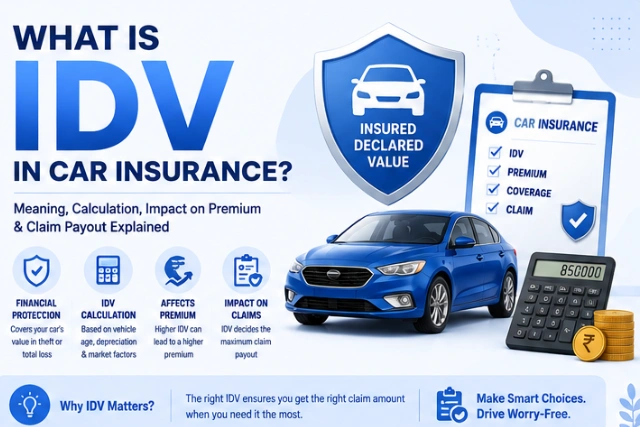
IDV (Insured Declared Value) is the estimated current value of your car after depreciation, and it generally represents the maximum amount payable if your vehicle is declared a total loss or stolen, subject to your policy's terms. A higher IDV usually means a higher premium, but it also raises the maximum amount you could claim.
Example - If the applicable valuation gives your car an IDV of ₹7 lakh and the car is later declared a total loss, the settlement may be based on that ₹7 lakh IDV, subject to the policy terms and applicable deductions.
After reading this guide, you'll know:
- What IDV actually means
- How insurers calculate it
- How it affects premiums
- Whether you should increase or decrease IDV
- Mistakes to avoid
- How to maximize claim settlement
At a Glance
| Feature | Details |
| Full Form | Insured Declared Value |
| Used For | Total loss and theft claims |
| Affects Premium | Yes |
| Changes Every Year | Yes |
| Includes Registration Cost | No |
| Based On | Vehicle age and depreciation |
| Regulated Under | IRDAI framework |
If you've ever stared at your car insurance quote and wondered why one number keeps changing your premium more than anything else, that number may be the vehicle's IDV, one of the key figures used to determine your own-damage coverage and premium. It's one of those terms every policy mentions but few people actually understand until the day they need to file a claim — and by then, it's too late to fix a mistake. This guide walks through what IDV is in car insurance, how it's actually calculated, and how it compares with Return to Invoice cover when your car is stolen or declared a total loss.
Not sure if your current IDV actually matches your car's real value? Ask E-Insure First — we'll check it for you, free.
What is IDV in Car Insurance?
So, what is IDV in car insurance policy terms, exactly? IDV stands for Insured Declared Value it's the sum insured for your car's own-damage cover, calculated as the manufacturer's listed selling price minus depreciation based on your car's age, plus the value of any registered accessories. Think of it as insurance's answer to the question: "If this car vanished tomorrow, what's it actually worth today, not what you paid for it three years ago?"
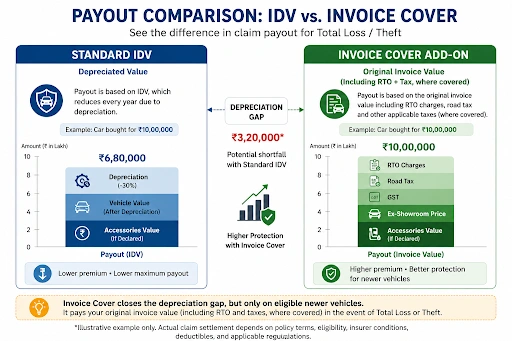
Real-life example: Say you bought a car for ₹10 lakh three years ago. It's not worth ₹10 lakh anymore; wear, age, and market depreciation have brought that number down. Your insurer applies a standard depreciation percentage based on the car's age, and the resulting figure, say ₹6.8 lakh, becomes your IDV. That's the ceiling on what a total loss or theft claim would pay out, not the original purchase price.
Why Should Every Car Owner Care About IDV?
Here's the question IDV actually answers: what happens if my car is stolen tomorrow, or written off completely? IDV becomes particularly important when a covered event results in theft or total loss/constructive total loss. The actual claim settlement remains subject to the policy's terms, exclusions, deductibles and applicable conditions.
- Theft - if your car is stolen and never recovered, IDV is the base claim amount.
- Total loss - if repair costs exceed a certain threshold of the car's value, insurers often declare it a total loss and pay out based on IDV.
- Flood damage - severe flood damage that renders the car unrepairable is settled the same way.
- Fire - a car destroyed by fire is treated as a total loss claim.
- Major accidents - if damage is severe enough to be a "constructive total loss," IDV again becomes the settlement basis.
An IDV set too low means an underinsured car — you'll get less than you actually need to replace it. Set too high, and you're simply paying more premium than necessary for coverage you'll likely never fully use.
How IDV Affects Different Types of Claims
| Claim Type | Does IDV Matter? |
| Theft | Yes |
| Total Loss | Yes |
| Constructive Total Loss | Yes |
| Minor Accident | No |
| Windshield Damage | No |
| Bumper Scratch | No |
For repairable damage dents, scratches, glass, most collision repairs the insurer pays based on actual repair costs under your policy terms, not your IDV. IDV only comes into play once a claim crosses into total loss or theft territory.
When Does IDV Usually Not Determine the Settlement?
IDV is generally not used to settle:
For repairable own-damage claims, such as eligible dents, scratches, glass damage or bumper damage, the claim is generally assessed based on repair costs and the policy's applicable terms, deductibles and depreciation provisions. IDV becomes particularly important when the vehicle is treated as a total loss, constructive total loss or eligible theft claim.
Instead, these are settled according to actual repair costs, your policy terms, applicable deductibles, standard depreciation rules (unless Zero Dep applies), and any other applicable conditions IDV simply isn't part of that calculation.
Quick Example
Car price: ₹10 lakh
After 3 years of ownership: IDV: ₹6.8 lakh
If declared a total loss: Maximum payable amount: ₹6.8 lakh (subject to policy terms, deductions, and any outstanding loan settlement)
How is IDV Calculated?
The IRDAI motor-insurance guidance states that the vehicle's sum insured is called IDV and should reflect its current market value. It also advises consumers to compare IDVs along with premiums and coverage. The formula insurers use is more straightforward than most people expect:
Ex-Showroom Price − Depreciation + Registered Accessories = IDV
A few components worth understanding:
- Ex-showroom price - the manufacturer's current listed price for your car's exact make, model, and variant, not what you personally paid for it.
- Depreciation - a fixed percentage based on your car's age, set under IRDAI's standard schedule (detailed below).
- Accessories - non-standard fitted accessories, if registered with the insurer, are valued separately and depreciated too.
- Market factors - registration cost, road tax, and insurance cost itself are excluded from IDV entirely.
IDV Calculation Flow:
Manufacturer's ex-showroom price
↓
Apply age-based depreciation percentage
↓
Add value of registered accessories (depreciated separately)
↓
Result = Your car's IDV for the policy year
IDV Calculation Examples
Example 1: New Car
A car purchased within the last 6 months typically carries just 5% depreciation, so IDV stays very close to the ex-showroom price — reflecting how little value a nearly-new car has actually lost.
Example 2: 3-Year-Old Car
At the 2–3 year mark, standard depreciation sits around 30%. A ₹10 lakh car would carry an IDV close to ₹7 lakh before accessory adjustments, dropping further as the car approaches the 3-4 year band.
Example 3: Electric Car
EVs follow the same age-based depreciation framework, but battery replacement cost and a still-maturing resale market mean IDV negotiations for EVs can vary more between insurers than for conventional petrol or diesel cars.
Example 4: Luxury Car
Luxury vehicles depreciate on the same percentage schedule, but because the starting ex-showroom price is so much higher, even a "small" percentage swing in IDV represents a much larger rupee difference — making accurate IDV-setting especially important at this price point.
Depreciation Table
Traditional standard motor-policy IDV schedules use age-based depreciation, with percentages such as 5% for vehicles up to six months old and 50% for vehicles between four and five years old. However, IDV should ultimately be checked against your insurer's current policy wording and valuation method.
| Vehicle Age | Depreciation for IDV |
| Not exceeding 6 months | 5% |
| 6 months - 1 year | 15% |
| 1 - 2 years | 20% |
| 2 - 3 years | 30% |
| 3 - 4 years | 40% |
| 4 - 5 years | 50% |
| Beyond 5 years | IDV mutually agreed between insurer and insured, based on the manufacturer's current listed selling price |
This depreciation schedule is specifically for IDV/sum insured purposes — it's a different calculation from the part-wise depreciation applied during an actual repair claim (which factors in plastic, rubber, and metal parts separately).
How IDV Changes Every Year
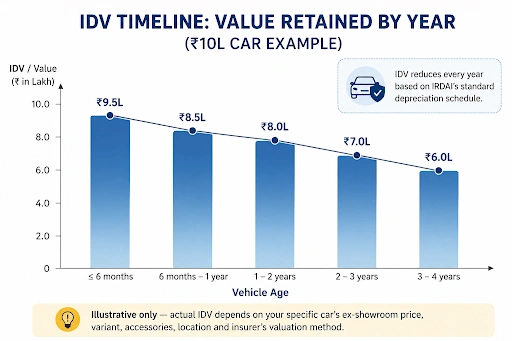
Year 1 - Modest depreciation, IDV close to purchase price
Year 2 - Depreciation increases, IDV drops further
Year 3 - Continued step-down per the schedule above
Year 5 - IDV now negotiated between you and the insurer rather than fixed by formula
Every renewal - Your claim value shifts accordingly, so it's worth checking the new IDV each year rather than assuming it's unchanged
IDV vs. Market Value, Invoice Value, Sum Insured & Resale Value
IDV vs. Market Value
Market value is what your car could actually sell for today in the open used-car market — influenced by condition, demand, and location. IDV is a formula-based insurance figure that doesn't account for those real-world variables, so the two numbers often diverge, especially for well-maintained cars or ones in high demand.
IDV vs. Invoice Value
Invoice value is what you actually paid at purchase, including taxes and on-road costs. IDV strips out registration and road tax entirely and applies depreciation on top — so IDV is almost always lower than your original invoice value, even in year one.
IDV vs. Sum Insured
For car insurance, IDV effectively is the sum insured for own-damage cover — they're the same figure, just different terminology. This is different from health insurance, where "sum insured" is chosen independently rather than formula-derived.
IDV vs. Resale Value
This is the comparison most guides skip. Resale value depends on real buyer demand, car condition, mileage, and local market trends — none of which the IDV formula considers. A well-maintained, low-mileage car might have a resale value higher than its calculated IDV, which matters if you're deciding whether to negotiate your IDV upward at renewal.
IDV vs. Invoice Cover
| Feature | IDV | Invoice Cover |
| Covers depreciation | Yes, reduces payout accordingly | No — covers the original invoice value in eligible cases |
| Available on older cars | Yes | Usually limited to newer cars, typically within 3 years |
| Premium | Lower | Higher |
| Theft claims | Yes | Yes, if included as an add-on |
Return to Invoice cover is an add-on specifically designed to close the gap IDV leaves behind — it pays your original invoice value (including registration and road tax) rather than the depreciated IDV, but only for total loss or theft on eligible, typically newer, vehicles.
Can You Choose Your Own IDV?
Yes. Many insurers allow adjustments within an approved range, although the final IDV must align with their underwriting guidelines and applicable regulations.
To an extent, yes — most insurers allow some negotiation within a permitted range around the calculated figure:
If your car is new - Keep IDV at or near the calculated maximum for full protection
If your car is older - Compare the calculated IDV against realistic market value.
Then balance premium cost against how much protection you actually need.
What Happens If IDV Is Too High?
Setting IDV artificially high doesn't help you the way it might seem to:
Higher premium - your own-damage premium is a percentage of IDV, so inflating it directly inflates your cost.
No extra claim amount - insurers pay based on actual loss, not your declared ceiling.
Insurer won't pay above actual loss - a total loss claim is settled at IDV or actual value, whichever applies under policy terms, not simply whatever number you picked.
Overinsurance doesn't increase payout - you can't profit from insurance by over-declaring value; you'll just be paying more premium for no real benefit.
What Happens If IDV Is Too Low?
Correct IDV: ₹8,00,000
↓
Car stolen
↓
Claim ≈ ₹8 lakh
Low IDV: ₹5,50,000
↓
Car stolen
↓
Claim ≈ ₹5.5 lakh
Same car, same incident — a much smaller payout simply because the declared value was set too low. That gap comes directly out of your pocket when you go to replace the vehicle.
IDV and Car Loans
Scenario: Car loan outstanding: ₹8 lakh. IDV: ₹6 lakh. Car is stolen.
Outcome: The insurer pays ₹6 lakh, subject to policy terms. You may still owe your lender the remaining loan balance, since the insurance payout and your loan balance aren't automatically the same number.
This is exactly why keeping IDV realistic — not artificially low — matters most in the early years of a loan, when the outstanding balance is often higher than a depreciated IDV would cover.
Should You Lower the IDV to Save Premium?
| Situation | Good Idea? |
| New car | No - you'd be underinsuring a car worth close to full price |
| 2-year-old car | Usually no - the gap between savings and risk isn't worth it yet |
| 8-year-old car | Sometimes - if the car's real value is genuinely low, a lower IDV may be reasonable |
| Selling soon | Depends - weigh the short remaining policy period against the reduced payout risk |
How Different Insurers Decide IDV
While the depreciation schedule is standardized, insurers still factor in:
- Age - the primary driver of the depreciation percentage applied
- City - registration location can slightly affect ex-showroom price references
- Make and model - different manufacturers price differently, which flows directly into IDV
- Variant - trim-level differences change the base ex-showroom figure
- Fuel type - petrol, diesel, CNG, and EV variants of the same model can carry different base prices
- EV-specific factors - battery value and evolving resale data
- Demand - high-demand models sometimes see slightly different insurer valuations
- Condition - particularly relevant if you're negotiating IDV upward at renewal
Factors That Do NOT Affect IDV
| Factor | Affects IDV? |
| Mileage | No |
| Driver age | No |
| Claim history | No |
| Car color | No |
| Fuel type | Yes (through model pricing) |
| Vehicle age | Yes |
Driver age and claim history affect your premium and NCB, not your car's IDV — a common point of confusion worth clearing up.
IDV During Renewal
IDV Renewal Flow -
Renewal Notice Received - Check Default IDV Shown - Compare vs. Real Market Value - Negotiate or Accept, Then Pay Premium Skipping the "compare" step is the most common renewal mistake
This is a step most car owners skip entirely, and it's worth pausing on:
Default IDV: Insurers typically auto-populate a renewal IDV based on the standard depreciation schedule — it's rarely flagged as something to review.
Negotiation: You can usually request an adjustment within the insurer's permitted band if you believe the default figure doesn't reflect your car's real condition or market value.
Renewal mistakes: Auto-accepting the pre-filled IDV without checking it is the single most common renewal mistake — especially for well-maintained older cars.
When to review: Every renewal, but especially if you've added expensive accessories, if your car's market segment has shifted, or if it's crossing into a new depreciation band.
Renewing soon and not sure if your IDV is set correctly? E-Insure First can review it with you before you renew.
Questions to Ask Before Renewal
- Has my IDV changed from last year?
- Is it too low for what I'd actually need to replace my car?
- Is Zero Dep still available and worth adding?
- Are my accessories included and correctly valued?
- Has my car crossed the five-year depreciation threshold, where IDV becomes negotiable rather than fixed?
When Can an Insurer Reject Your Requested IDV?
Your requested IDV may be declined if:
- It falls outside the insurer's permitted range for your car's age and category.
- The vehicle has undisclosed modifications affecting its valuation.
- The declared value can't be supported by documentation you provide.
- The insurer's own valuation differs based on the vehicle's condition or its market references.
Documents Required for IDV Disputes
If you're disputing an IDV figure or requesting an adjustment, having these ready speeds things up considerably:
- Original purchase invoice
- Registration Certificate (RC)
- Photos of the vehicle's current condition
- A recent repair estimate, if relevant to the dispute
- Your previous policy document, for reference
- Surveyor report, if one has already been conducted
- Service history records
IDV for Different Types of Cars
Hatchbacks: Follow the standard depreciation schedule closely; IDV differences between insurers tend to be minor.
Sedans: Same formula applies, though variant-level price differences can be more pronounced.
SUVs: Higher ex-showroom prices mean IDV swings represent larger absolute amounts, worth double-checking at every renewal.
Luxury cars: Same percentage schedule, much larger rupee impact — precision matters more here.
EVs: Depreciation follows the standard schedule, but battery value and a still-developing resale market can make IDV negotiation less predictable.
Imported cars: Ex-showroom price references can be harder to pin down, since imported models may not have a straightforward domestic price list.
Vintage cars: Typically fall outside the standard depreciation schedule entirely, valued instead through specialist appraisal and mutual agreement.
IDV for Used Cars
Used Car IDV: What Actually Carries Over Previous Owner's IDV (Does NOT carry over) → New Policy Issued → IDV Recalculated by Current Age → Fresh IDV for New Owner
Buying a used car brings its own set of IDV questions:
Buying a used car - Don't assume the previous owner's IDV carries over — a new policy recalculates IDV based on the car's current age and the standard depreciation schedule.
Transferring insurance - Insurance transfer to a new owner typically involves a fresh IDV assessment, not an automatic continuation of the seller's figure.
Second owner - Ownership history itself doesn't affect IDV — the car's age and condition do.
Older than 5 years - IDV moves from a fixed formula to mutual agreement between you and the insurer, so it's worth actively negotiating rather than accepting the first figure offered.
How insurers calculate it for used cars - the same ex-showroom-price-minus-depreciation approach applies, using the car's actual age from manufacture, not from when you purchased it secondhand.
Negotiation tip: for used cars beyond the 5-year mark, gather supporting evidence — service records, recent valuations, or comparable listings — before requesting an IDV above the insurer's default suggestion.
Does Zero Dep Affect IDV?
No — and this mix-up is extremely common. Zero depreciation cover affects how much you're reimbursed for individual repaired or replaced parts during a regular claim, waiving the standard part-wise depreciation deduction. IDV is a completely separate figure that only comes into play for total loss and theft settlements. Adding zero dep to your policy doesn't change your IDV at all, and a higher IDV doesn't affect how zero dep pays out on a repair claim either — they operate independently.
Common Myths About IDV
Myth: A higher IDV guarantees you'll get the full purchase price back.
Fact: No. Claim settlement still depends on your policy's terms and conditions, applicable deductions, and the specific circumstances of the loss — IDV is a ceiling, not an automatic payout amount.
Myth: IDV includes your car's registration and road tax costs.
Fact: It doesn't. IDV is based purely on the ex-showroom price minus depreciation, plus registered accessories.
Myth: Once set, your IDV stays the same every year.
Fact: IDV recalculates at every renewal based on your car's updated age and depreciation band, so it changes annually unless you specifically negotiate otherwise.
Myth: Zero depreciation cover increases your IDV.
Fact: It doesn't. Zero dep affects repair reimbursement on individual parts; IDV governs total-loss and theft settlements. The two are unrelated.
Real Claim Stories
Total Loss / Theft Claim Journey Incident Occurs → Reported to Insurer → Survey / Investigation → Total Loss / Theft Confirmed → IDV Payout IDV becomes the settlement basis only once total loss or theft is confirmed
Theft Claim
A 2-year-old hatchback is stolen from a parking lot and never recovered. The owner's IDV, set at renewal three months earlier, becomes the base settlement figure — reinforcing why checking IDV accuracy before renewal matters, not after a loss.
Accident Claim (Constructive Total Loss)
A sedan is severely damaged in an accident, and repair costs are assessed above the insurer's total-loss threshold relative to IDV. Rather than paying for repairs, the insurer settles the claim based on IDV, treating it as a constructive total loss.
Flood Claim
A car submerged in flash flooding suffers engine and electrical damage beyond economical repair. The claim is settled on the IDV basis rather than itemized repair costs, since the vehicle is deemed unrepairable.
Fire Claim
A vehicle destroyed in a fire is settled the same way — IDV becomes the ceiling for the payout, regardless of how much the owner originally paid for the car.
Common Mistakes
- Choosing the lowest available IDV purely to shave premium cost
- Ignoring accessories when declaring value, leaving them effectively uninsured
- Confusing IDV with market value or resale value
- Assuming a claim will simply equal the original purchase price
How to Check Your Car's IDV Online
- Visit your insurer's official website.
- Enter your car's registration number.
- Select your car's exact model and variant.
- Review the calculated IDV shown for your policy.
- Compare it against your car's realistic current market value.
- Adjust within the permitted range, if your insurer allows it.
Expert Checklist Before Buying Car Insurance:
- Check IDV
- Compare insurers
- Verify accessories are declared
- Check available add-ons
- Compare premium across quotes
- Read the policy wording in full
Expert Tips
- Review your IDV at every single renewal — don't assume the auto-populated figure is right for your car's actual condition.
- If you've added expensive accessories, make sure they're registered with the insurer and reflected in your IDV.
- For a nearly-new car, resist the temptation to lower IDV for a small premium saving — the protection gap isn't worth it.
- For an older, well-maintained car, it's worth asking your insurer directly whether a higher-than-default IDV is negotiable.
- Keep a copy of your IDV figure and calculation basis each year, so you can spot unexplained jumps or drops at renewal.
Common Terms You Should Know
| Term | What It Means |
| IDV | Insured Declared Value — your car's depreciated value for total loss and theft claims |
| NCB | No Claim Bonus — a premium discount for each claim-free year |
| Zero Depreciation | An add-on that waives part-wise depreciation deductions during repair claims |
| Total Loss | When a vehicle is damaged beyond economical repair |
| Constructive Total Loss | When repair cost exceeds a set threshold relative to IDV, treated as a total loss |
| Cashless Claim | A claim settled directly between the insurer and a network garage, without upfront payment |
| Own Damage Cover | Coverage for damage to your own vehicle, separate from third-party liability |
| Comprehensive Insurance | A policy combining own damage cover and mandatory third-party liability |
| Invoice Cover | An add-on paying the original invoice value rather than depreciated IDV, on eligible newer cars |
Latest IRDAI Rules Related to IDV
- A standard age-based depreciation schedule applies uniformly across insurers for vehicles up to 5 years old.
- For vehicles beyond 5 years, IDV is mutually agreed between insurer and insured rather than formula-fixed.
- Policyholders generally retain some right to negotiate IDV within insurer guidelines, though final approval rests with the insurer.
- Since practices can evolve, always check your specific insurer's current policy wording rather than relying solely on general guidance like this article.
Insurance Expert Review: This guide has been reviewed against current IRDAI guidance and common motor insurance policy practices. Individual insurers may have different underwriting rules and valuation methods. Always verify the final IDV shown in your policy schedule before purchase or renewal.
Final Thoughts
What is IDV in car insurance for car owners, in the simplest terms: it's the number that decides what you'd actually get paid if the worst happened to your car. It's not your purchase price, not your car's resale value, and not something to blindly accept at every renewal without a second look. Check it every year, understand what it does and doesn't cover, and make sure it actually reflects your car's real value — not just whatever figure your insurer auto-fills.
Want a second opinion on whether your IDV is set correctly? Talk to E-Insure First — no charge for the review.
Frequently Asked Questions
What is IDV value in car insurance calculated from?
It's calculated from the manufacturer's ex-showroom price minus age-based depreciation, plus the value of any registered accessories.
Can IDV be increased?
Within limits, yes — most insurers allow some negotiation above the default calculated figure, particularly at renewal.
Is IDV negotiable?
Yes, within the range insurers permit around the standard calculated value, especially for cars beyond 5 years old where it's mutually agreed.
Does IDV affect No Claim Bonus (NCB)?
No. NCB is a percentage discount applied to your own-damage premium based on claim-free years; it's calculated independently of your IDV figure. For a detailed explanation, see our guide to NCB in car insurance.
Does Zero Dep increase IDV?
No. Zero depreciation cover affects repair claim reimbursement, not your car's declared value.
Does IDV affect minor accident claims?
No. IDV generally applies to total loss or theft claims. For repairable damage, the insurer usually pays repair costs according to the policy terms, applicable deductibles and depreciation (unless offset by add-ons like zero depreciation), and any applicable limits.
Can insurers refuse my requested IDV?
Yes, if it falls outside the permitted range based on the standard depreciation schedule and market guidelines.
Does IDV include accessories?
Only if those accessories are registered with the insurer and declared separately — unregistered accessories aren't factored into your IDV.
How often does IDV change?
IDV is generally reviewed at each policy renewal because the vehicle's age and applicable depreciation change over time. The exact valuation should be checked against your insurer's current policy terms.
What if I modify my car?
Registered modifications and accessories can be added to your declared value; unregistered modifications generally aren't covered or reflected in IDV.
Is IDV mandatory?
IDV is a required component of any comprehensive or own-damage motor policy — you can't have this type of cover without a declared value being set.
What happens after 5 years?
Beyond 5 years, IDV is no longer set by a fixed formula and instead becomes a figure mutually agreed between you and the insurer.
Does IDV apply to EV batteries?
EV batteries are factored into the overall vehicle valuation rather than insured as a separate line item, though this can vary by insurer given the evolving EV resale market.
Why do insurers show different IDVs for the same car?
Differences usually come from which ex-showroom price reference an insurer uses, how they handle accessories, and minor variations in how depreciation bands are applied at the edges.
Does IDV affect own-damage premium?
Yes, directly – own-damage premium is calculated as a percentage of your IDV, so a higher IDV can increase the own-damage premium because IDV is one of the factors insurers use when pricing own-damage coverage.
How is IDV determined for discontinued models?
Insurers typically reference the last available manufacturer price list for that model before applying the standard depreciation schedule, or rely on documented market valuation where no current price list exists.
Editorial Note: This article is based on publicly available regulatory guidance and insurer policy documents. Insurance terms and valuation methods may change, so always review your insurer's current policy wording before purchasing or renewing coverage. E-Insure First is an independent insurance advisory platform led by Director Sunil Goyal, helping Indian policyholders compare and buy insurance policies.