Written by the E-Insure First Content Team | Reviewed by Sunil Goyal, Director, E-Insure First | Last updated: September 2026
Quick Answer
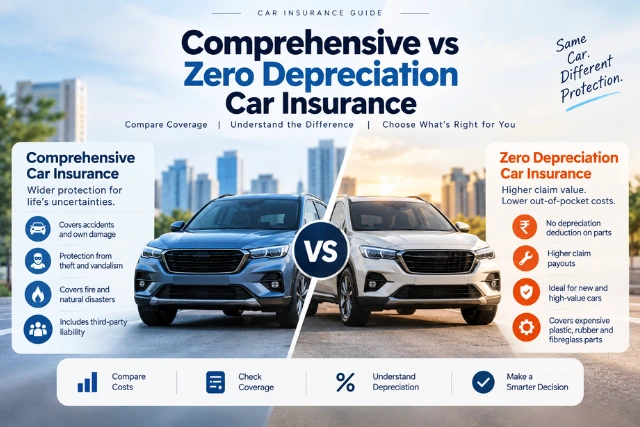
In the comprehensive vs zero depreciation car insurance comparison, comprehensive insurance covers accident damage, theft, fire, and natural disasters, but the insurer deducts depreciation on replaced parts before paying out. Zero depreciation is an add-on bought on top of a comprehensive policy that removes most of that deduction, so you get a higher claim payout for a slightly higher premium. If you own a new or expensive car, zero depreciation is usually worth the extra cost.
If you've spent any time comparing car insurance quotes, you've probably run into this exact fork in the road: buy the plain comprehensive policy, or pay extra for zero depreciation. The decision can be confusing because the two terms are often explained poorly. What really matters is how much you could pay out of pocket on a claim without zero depreciation cover. This guide breaks that down with a real claim example, so the choice is less about jargon and more about your specific car.
If you're also comparing how to buy your policy, our guide to online vs offline car insurance explains the differences in the buying process. It's a genuinely confusing decision because both terms get thrown around loosely.
| Question | Short Answer |
| Is zero dep a separate policy? | No, it is an add-on to comprehensive insurance. |
| Does zero dep remove all claim deductions? | No, deductibles and policy exclusions can still apply. |
| Is zero dep good for new cars? | It can be particularly useful for newer and high-value cars. |
| Can old cars get zero dep? | Eligibility depends on the insurer and vehicle age. |
What is Comprehensive Car Insurance?
Comprehensive car insurance is a package policy that combines two things: mandatory third-party liability cover (for damage or injury you cause to others) and own-damage cover (for damage to your own vehicle). It protects against accidents, theft, fire, and natural disasters like floods or earthquakes, along with optional add-ons you can layer on top.
| Covered | Not Covered (Standard Comprehensive) |
| Accidental damage to your car | Mechanical or electrical breakdown |
| Theft of the vehicle | Normal wear and tear |
| Fire, explosion, self-ignition | Driving without a valid licence |
| Natural disasters (flood, cyclone, earthquake) | Driving under the influence |
| Riots and malicious acts | Consequential loss or depreciation on parts (unless zero dep is added) |
| Third-party liability (mandatory) | Damage outside the policy's geographic limits |
Crucially, even a full comprehensive policy still deducts depreciation from the cost of any replaced parts during a claim — that's the gap zero depreciation is built to close. Understanding IDV in car insurance is also important because the vehicle's insured value can affect how your claim is assessed.
What is Zero Depreciation Car Insurance?
Zero depreciation cover, also called nil depreciation, bumper-to-bumper cover, or a zero dep add-on, waives most or all of the depreciation deduction on eligible parts during a claim. It's not something you can buy on its own; it's an add-on layered on top of an existing comprehensive policy.
Depreciation matters in claims because insurers don't pay for a brand-new part at full price when your car itself has aged. Under a standard comprehensive claim, they deduct a percentage based on the part's material and your vehicle's age before paying out. Zero dep reduces or removes the depreciation deduction for eligible parts, subject to the terms, exclusions, and limits of the policy.
Eligibility is typically capped at vehicles up to 5 years old, with some insurers extending this to 7 years. Common exclusions include mechanical and electrical failures, and the compulsory deductible also continues to apply, with the applicable amount depending on the vehicle's engine capacity and policy terms.
Comprehensive vs Zero Depreciation Car Insurance - Comparison Table
Here's how comprehensive and zero depreciation insurance compare side by side, so you can see exactly where the two diverge:
| Feature | Comprehensive Insurance | Zero Depreciation Insurance |
| Coverage | Own damage + third-party liability | Comprehensive + zero depreciation add-on |
| Depreciation Deduction | Yes, per IRDAI's standard schedule | No, on eligible parts |
| Premium | Lower | Higher (roughly 10-25% more on the own-damage portion) |
| Claim Amount | Lower, after depreciation deductions | Higher, closer to actual repair cost |
| Best For | Budget-conscious owners, older cars | New and premium cars |
| Add-on Required | No | Yes - can't be bought standalone |
| Availability | All eligible vehicles | Usually vehicles up to 5-7 years old |
How Does Depreciation Affect Your Claim? (A Realistic Example)
Here's how depreciation can affect the amount your insurer pays. Say your car needs ₹45,000 in repairs after a minor collision, including an ₹18,000 plastic bumper replacement.
| Without Zero Dep | With Zero Dep | |
| Total repair cost | ₹45,000 | ₹45,000 |
| Depreciation deducted on plastic/rubber parts (50% per IRDAI's standard rate) | Deducted | Not deducted |
| Insurer pays (approx.) | ~₹30,000 | ~₹43,500 |
| You pay (approx., excluding compulsory deductible) | ~₹15,000 | Only the compulsory deductible (₹1,000–₹2,000) |
This example is illustrative to show the scale of the difference. Actual depreciation follows IRDAI's fixed schedule, 50% on rubber, nylon, and plastic parts and tyres; 30% on fibreglass components; nil on glass; and an age-based percentage on metal parts. Your exact payout depends on which specific parts are damaged and your vehicle's age.
This example is illustrative to show the scale of the difference. If you're comparing zero dep with other useful car insurance add-ons, it's also worth understanding return to invoice cover and when it can help after a total loss.
What's Covered Under Comprehensive Insurance?
- Accidents involving your vehicle
- Theft of the car
- Fire and explosion
- Flood, cyclone, and hailstorm damage
- Earthquake damage
- Riots and strikes
- Damage caused by animals
- Third-party liability, including bodily injury and property damage
What Does Zero Depreciation Cover?
Zero dep applies depreciation waivers to specific part categories:
- Plastic parts - bumpers, panels, trims
- Rubber parts - seals, mouldings
- Fibreglass components
- Metal parts - as per your specific policy terms
- Paint - where the policy includes it
Common exclusions still apply: mechanical or electrical breakdowns, general wear and tear, and consumables like nuts, bolts, and lubricants unless a separate consumables add-on is also purchased.
Pros and Cons of Comprehensive Insurance
| Advantages | Disadvantages |
| Lower premium than comprehensive plus add-ons | Depreciation deduction reduces your actual payout |
| Covers both own damage and third-party liability | Older or damaged parts get paid at a fraction of replacement cost |
| Available for nearly all eligible vehicles regardless of age | Out-of-pocket cost on claims can be significant for plastic/rubber-heavy repairs |
Pros and Cons of Zero Depreciation Insurance
| Advantages | Disadvantages |
| Significantly higher claim payout on eligible parts | Higher premium, typically 10-25% more on the own-damage portion |
| Especially valuable for plastic and rubber-heavy repairs | Not available for older vehicles (usually past 5-7 years) |
| Reduces financial stress after an accident | Some insurers cap the number of zero dep claims per year |
| Can reduce out-of-pocket costs and simplify depreciation calculations for eligible parts | Compulsory deductible still applies regardless |
Premium Difference — Is Zero Dep Worth the Extra Cost?
The premium difference for zero dep usually works out to roughly 10–25% more on your own-damage premium, which for most private cars translates to somewhere between ₹800 and ₹4,000 extra per year, depending on the vehicle's value and city. Against that, a single claim involving a plastic bumper or a couple of panels can easily save you ten times that amount in avoided depreciation deductions, as the earlier example shows. Your overall car insurance cost can also be affected by factors such as your NCB in car insurance, vehicle value, location, and claim history.
A single claim involving parts subject to significant depreciation can make the additional premium worthwhile, particularly for newer or high-value vehicles. If you go multiple years without any claim, the added premium is simply a cost you didn't need. In practical terms, you're paying a higher annual premium to reduce the amount you may have to pay during an eligible claim.
Who Should Buy Comprehensive Insurance (Without Zero Dep)?
- Owners of older cars, particularly past the typical 5-7 year zero dep eligibility window
- Budget-conscious buyers prioritising the lowest possible premium
- Low annual mileage drivers with minimal accident exposure
- Rural or low-traffic driving conditions with lower collision frequency
Who Should Buy Zero Depreciation Insurance?
- Owners of new cars, especially within the first 2-3 years
- Luxury or high-value vehicles where parts cost significantly more
- Frequent city drivers navigating dense traffic and higher collision risk
- Anyone with a high repair-cost vehicle where even minor damage is expensive to fix
- First-time car owners who are statistically more likely to be involved in minor incidents
Common Myths About Zero Dep Insurance
- Zero dep covers everything - It doesn't. Mechanical and electrical failures, and general wear and tear, remain excluded.
- Zero dep is a standalone policy - It's always an add-on; you can't buy it without a comprehensive base policy.
- Older cars always qualify - Most insurers cap eligibility at 5-7 years, after which the add-on isn't offered at all.
- Unlimited zero dep claims are always allowed - This varies by insurer, some do offer unlimited claims, others cap it, so check your specific policy wording rather than assuming.
- It removes every out-of-pocket expense - The compulsory deductible still applies on every claim, zero dep or not.
Common Mistakes to Avoid When Buying Car Insurance
- Choosing the cheapest premium without checking what's excluded - A low price often means a thinner policy.
- Ignoring deductibles - When comparing quotes, which can quietly change your real out-of-pocket cost.
- Not checking add-on eligibility before assuming zero dep applies - Always confirm your car's age against the insurer's cutoff first.
- Forgetting policy renewal deadlines - Which can cost you your No Claim Bonus if the lapse runs long enough.
- Assuming every repair is fully covered - Even with zero dep, when mechanical failures and consumables often aren't.
How to Choose Between Comprehensive and Zero Dep Insurance
Still weighing zero depreciation vs comprehensive car insurance for your own car? This table shows which option may make more sense in common situations.
| If You... | Choose |
| Bought a new car | Zero Dep |
| Own a 7 year-old car | Comprehensive |
| Drive daily in heavy traffic | Zero Dep |
| Drive occasionally, low mileage | Comprehensive |
| Own a luxury or high-value vehicle | Zero Dep |
| Are on a tight premium budget with an older car | Comprehensive |
Key Takeaways
- Zero depreciation is not a separate insurance policy. It only exists as an add-on to comprehensive cover.
- It generally increases your claim payout but also increases your premium by roughly 10-25%.
- Best suited for new, premium, or frequently driven vehicles.
- Older cars typically past 5 years, sometimes 7 depending on the insurer, often aren't eligible at all.
- A compulsory deductible (₹1,000 or ₹2,000, based on engine size) still applies even with zero dep.
- Claim limits vary by insurer. Some cap zero dep claims per year, others offer unlimited claims, so this is worth checking before you buy.
Final Verdict
Comprehensive insurance provides broad protection at a lower premium, covering accidents, theft, fire, and natural disasters alongside mandatory third-party liability. Zero depreciation enhances that same comprehensive policy by reducing or removing depreciation deductions during eligible claims, at a modest premium increase. For new or high-value cars, that extra cost is usually worthwhile, since it can significantly cut your out-of-pocket repair bill. In the comprehensive vs zero depreciation insurance for car decision, there's no universally right answer. It comes down to your vehicle's age, value, how often you drive, and how much premium headroom your budget has.
For official information related to vehicle and road transport services, you can also refer to Parivahan Sewa.
Frequently Asked Questions
Is zero depreciation better than comprehensive insurance?
They're not competing options. Zero dep is an add-on to comprehensive, not an alternative to it. Whether it's "better" depends on your car's age and value; for new or expensive cars, it usually pays for itself.
Can I buy zero dep without comprehensive insurance?
No. Zero depreciation cover can only be purchased alongside a comprehensive policy. It doesn't exist as a standalone product.
Is zero dep worth the extra premium?
For new or high-value cars, generally yes. The added premium is typically far smaller than what a single depreciation-heavy claim would otherwise cost you out of pocket.
How many zero dep claims are allowed?
This varies by insurer. Some cap the number of zero dep claims per policy year, while others offer unlimited claims. Always confirm the exact limit in your specific policy wording.
Does comprehensive insurance cover depreciation?
No. Standard comprehensive insurance deducts depreciation on replaced parts during a claim. Only the zero depreciation add-on removes that deduction.
Which insurance is better for a new car?
Comprehensive with a zero depreciation add-on is generally the stronger choice for a new car, since new vehicles have higher part replacement costs and are typically still within the insurer's eligibility window.
Is bumper-to-bumper insurance the same as zero depreciation?
Yes. Bumper-to-bumper, nil depreciation, and zero dep cover all refer to the same add-on.
Can old cars get zero depreciation cover?
Usually not past 5-7 years of age, depending on the insurer. Beyond that window, most insurers stop offering the add-on regardless of the vehicle's condition.
Does zero dep cover tyres and batteries?
Coverage for tyres and batteries under zero dep varies by insurer and specific policy terms. Some include them under the rubber/plastic parts category, others exclude them or price them separately. Check your policy wording directly.
What is not covered under zero depreciation?
Mechanical and electrical breakdowns, general wear and tear, and the compulsory deductible are not waived by zero dep, regardless of your policy.
Editorial Policy & Sources: This article reflects IRDAI's standard motor insurance guidelines and depreciation schedule, along with publicly available insurer policy wordings, as of August 2026. It is reviewed periodically for accuracy. E-Insure First is an independent insurance advisory platform led by Director Sunil Goyal, helping Indian policyholders compare, buy and manage general insurance policies. Exact coverage, premium loading, and claim limits for zero depreciation vary by insurer and policy terms. Always verify specifics directly with your insurer before purchase.